
The committed minimalist: upgrade an everyday favorite
Replace one worn object and arrange to recycle, donate, or remove the old one with permission.
See fit and tradeoffs →Curated editorial collection · 357 ideas
Experiences, services, consumables, digital gifts, repairs, and one-in-one-out upgrades.
Replace one worn object and arrange to recycle, donate, or remove the old one with permission.
See fit and tradeoffs →
Choose an exact consumable, refill, membership, digital item, or service they already use.
See fit and tradeoffs →Plan a specific meal, walk, performance, class, or short trip with minimal physical residue.
See fit and tradeoffs →Complete a repair, digitization, donation run, maintenance task, or administrative chore they selected.
See fit and tradeoffs →Write a letter, record a story, make a playlist, or create a digital archive they can keep or delete freely.
See fit and tradeoffs →
Set aside an afternoon to mend one cherished wool blanket together using matching or deliberately visible wool yarn. Prepare a stable work surface, good light, and a practiced sample so the heirloom itself is not the first attempt.
See fit and tradeoffs →
Create washable shelf labels and bed-set tags that identify linen size, room, and rotation order at a glance. Fold complete sets inside one pillowcase so fitted sheets and matching pieces remain together.
See fit and tradeoffs →Plan one supper around folding a single dumpling style with two clearly labeled fillings and a tested cooking method. Prepare the work surface and most chopping in advance so the gift remains a shared meal rather than an instruction-heavy class.
See fit and tradeoffs →Prepare a labeled set of freezer-friendly breakfasts in single-meal portions using recipes the household has approved. Include ingredient, allergen, reheating, and use-by information on every package.
See fit and tradeoffs →Bring measured ingredients and lead a side-by-side pizza dough experiment using two fermentation times from one tested recipe. Bake both on the recipient's existing equipment and record the texture and flavor differences together.
See fit and tradeoffs →
Build or commission a removable divider insert around the recipient's twelve most-used cooking utensils rather than a generic compartment pattern. Leave one open section for the drawer's contents to change over time.
See fit and tradeoffs →Assemble the shelf-stable ingredients for one tested soup and one simple bread, with perishable additions listed separately rather than included. Package exact usable quantities and add a card showing active time, total time, allergens, and required equipment.
See fit and tradeoffs →Choose one incomplete family recipe and host a measured test session to resolve unclear ingredients, temperatures, timing, and yield. Photograph only the useful stages and record the cook's wording before producing a clean draft for everyone to review.
See fit and tradeoffs →
Reserve a specific half-day in which you handle an agreed meal, errand, childcare, pet task, or household responsibility while the recipient reads where they choose. Put the date, start and finish time, covered task, and easy rescheduling method in writing.
See fit and tradeoffs →Arrange lawful access to the same short book in each reader's preferred format, such as print, large print, ebook, or audiobook. Schedule two low-pressure conversations with optional prompts and enough time for either person to pause or change the plan.
See fit and tradeoffs →
Record a consenting family member reading a public-domain work, an original story, or a text they have permission to record. Edit only for clarity, divide the audio into short labeled tracks, and deliver it privately with a simple playback guide.
See fit and tradeoffs →Set up one afternoon to marble a limited stack of paper using a tested beginner method, washable tools, and a protected work surface. Plan two later uses for the dried sheets, such as book covers and gift tags, so the experiment becomes useful material.
See fit and tradeoffs →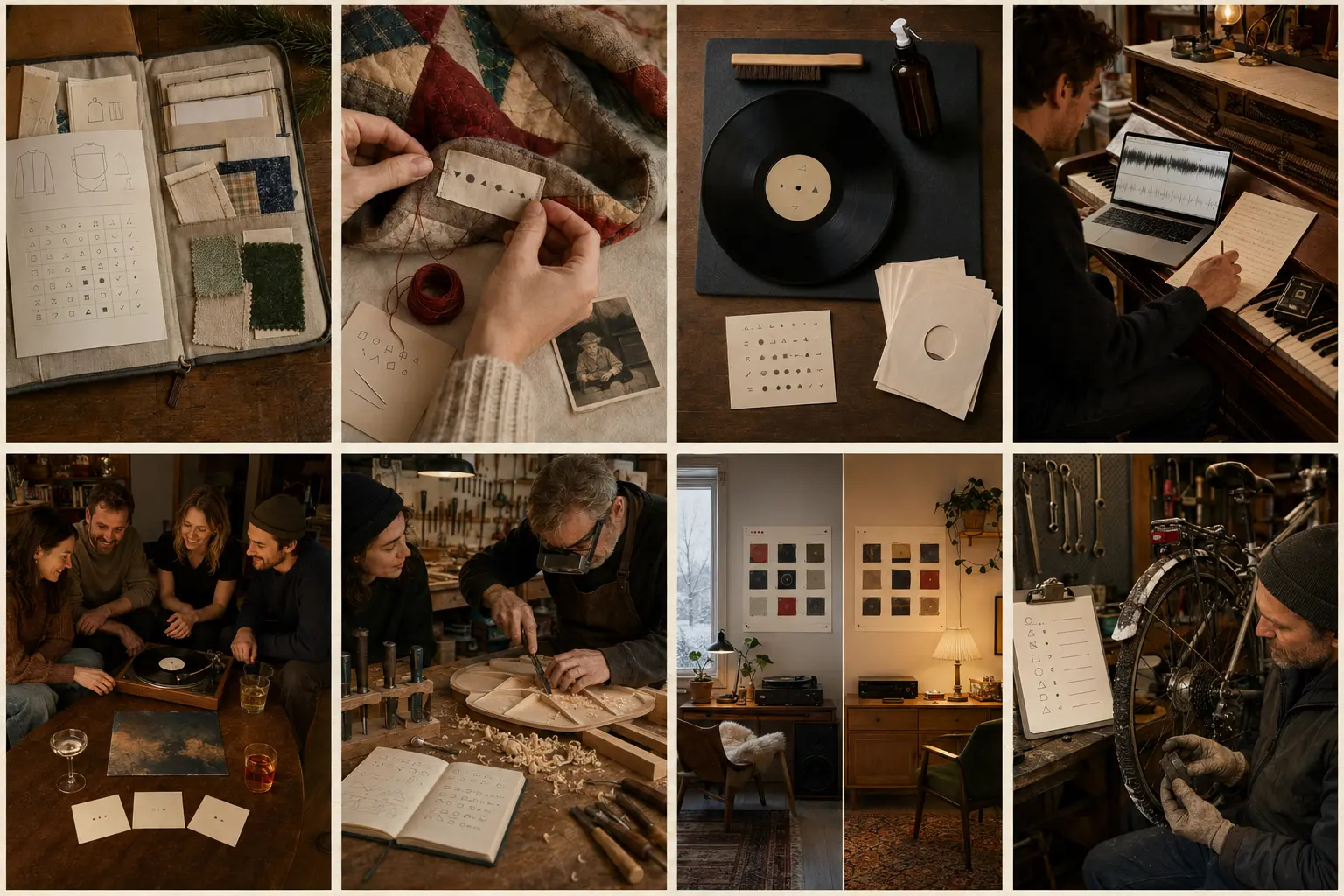
Prepare acid-free interview cards and washable fabric label blanks for documenting three completed quilts in the maker's own words. Record maker, date, materials, intended recipient, pattern source, and one honest story before lettering or stitching the final labels.
See fit and tradeoffs →Arrange for a qualified musician to transcribe one original or rights-cleared personal song from a recording into the notation format the recipient can use. Include a review round for key, lyrics, tempo, chord names, and performance notes before producing the clean copy.
See fit and tradeoffs →Host a ninety-minute listening evening around one album already owned or lawfully accessible, with a defined start, intermission, and finish. Prepare only three optional prompts about sound, context, and memory so conversation supports rather than interrupts the music.
See fit and tradeoffs →Arrange an educational visit with a working instrument builder or repair craftsperson who explicitly welcomes visitors. Define whether the visit includes observation, questions, a small demonstration, or a hands-on sample, and make clear that no purchase is expected.
See fit and tradeoffs →Create twelve dated prompts for exchanging one lawfully accessible album recommendation each month, alternating who chooses. Keep each note to why now, one listening detail, and one question, with no requirement to finish or respond immediately.
See fit and tradeoffs →Book a clearly scoped inspection with a qualified bicycle mechanic covering the recipient's actual winter-use concerns and a written estimate before any extra work. Include transport of the bicycle only if the recipient approves how and when it will be handled.
See fit and tradeoffs →
Create a voluntary two-household meal exchange plan with one tested dish each, a specific week, portion count, container return method, and complete ingredient labels. Include an easy opt-out and begin with a single exchange rather than announcing a recurring tradition.
See fit and tradeoffs →
Ask the child for a hero, a problem, and three favorite details, then record a ten-minute bedtime adventure in a familiar voice. Add a simple chapter image and a written transcript so the story can be heard or read together.
See fit and tradeoffs →Let the child choose one achievable dish, make the illustrated shopping list, and assign the adult only the safety tasks. Buy the ingredients, clear the schedule, and eat the result at a table the child sets in their own way.
See fit and tradeoffs →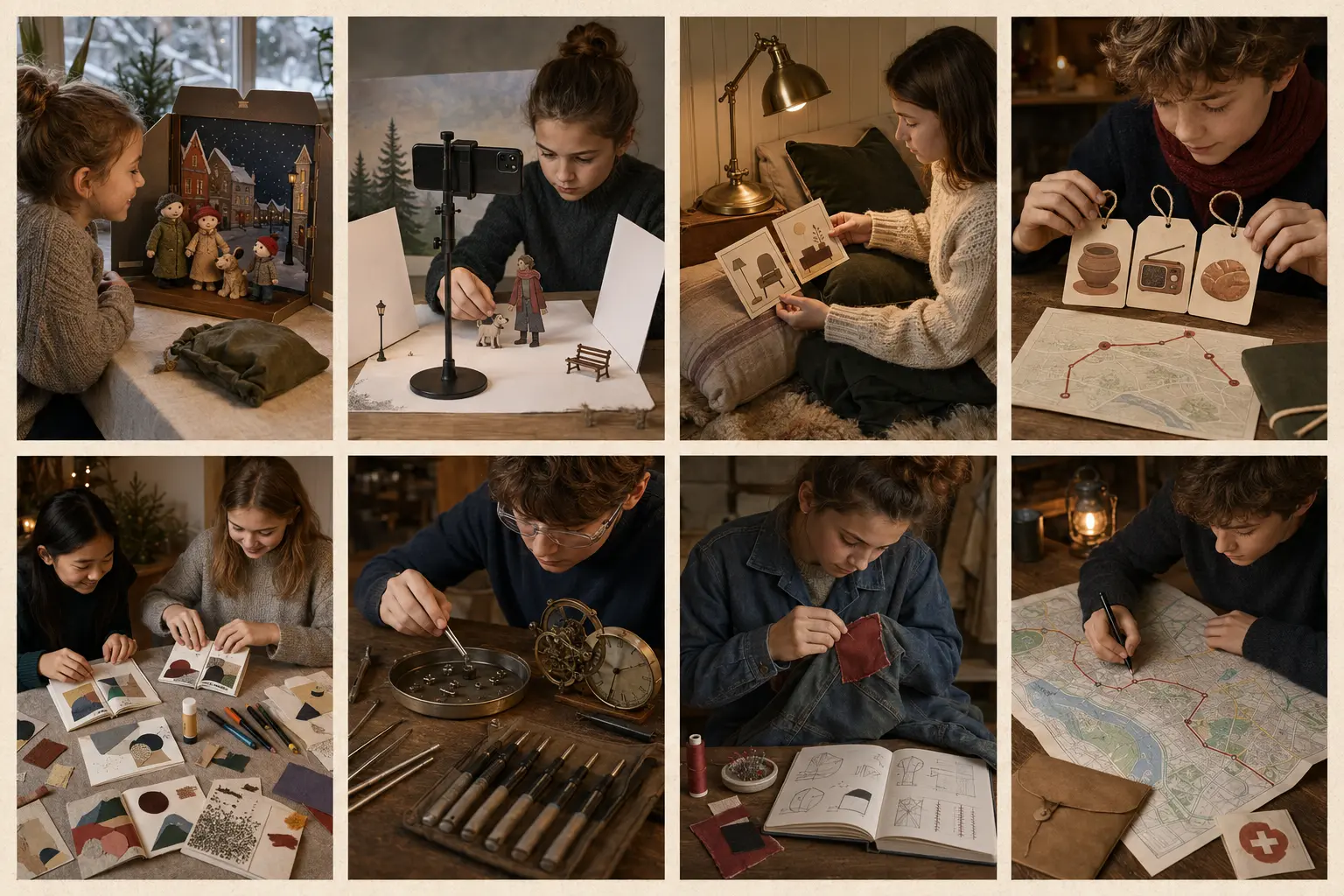
Offer a choice among several local mini-lessons or demonstrations, then let the tween select three short stops that fit one day. Handle registration, transport, food, and a quiet break so experimentation does not become a logistical burden.
See fit and tradeoffs →Give the teenager a clearly bounded day budget and let them design a route with one meal, one destination, and one unplanned stop. Agree on transport, check-in method, companion choice, accessibility, and backup meeting place before the day begins.
See fit and tradeoffs →
Arrange a paid, time-limited conversation with a practitioner in the teenager's actual medium and send three work samples only with consent. Ask the practitioner to discuss strengths, one next experiment, and the realities of the work rather than judging admissions potential.
See fit and tradeoffs →Invite the teenager to choose an age-appropriate performance and one companion, then purchase only after reviewing the venue together. Include transport, hearing protection, food, seating or standing expectations, and a firm return plan in the gift.
See fit and tradeoffs →Ask the adult child to name one concrete goal and the expense that would most usefully move it forward, such as a course fee, tool repair, travel document, or deposit. Transfer or pay the agreed contribution with a short note stating that it carries no reporting requirement or control over the final decision.
See fit and tradeoffs →Let the adult child choose one bounded skill such as hemming trousers, sharpening a hand tool, preserving a seasonal dish, or setting a formal table. Gather the exact materials, practice together once, and record only the steps the learner asks to keep.
See fit and tradeoffs →
Plan a visit that uses separate lodging or a defined daytime window, and tell the adult child explicitly that they will not provide a bed, meals, transport, or entertainment. Ask for one activity they would enjoy, handle its logistics, and leave unscheduled time around it.
See fit and tradeoffs →Offer a defined contribution toward the adult child's preferred holiday travel, including a train, flight, fuel, accessible ride, pet care, or baggage need. State clearly that the contribution may support another date or be declined if coming home is not right this year.
See fit and tradeoffs →Choose a real morning and take responsibility for wake-ups, breakfast, pet care, transport, questions, and cleanup from a written plan. Ask the parent whether they want sleep, solitude at home, or time elsewhere, then protect that choice without repeatedly checking in.
See fit and tradeoffs →Walk the property with the parent and agree on a short list such as storing hoses, clearing one path, cleaning tools, moving pots, or arranging a permitted pickup. Complete only the approved list, photograph anything needing a later decision, and remove waste through the appropriate local channel.
See fit and tradeoffs →Ask the parent and the artists to select a manageable number of pieces, then photograph them squarely with names, dates, and context verified. Create a searchable digital gallery and print only a short annual sequence the family chooses together.
See fit and tradeoffs →Choose one drawer or document box and work beside the parent to identify, date, and group only the materials inside it. Scan a small priority set, write names in reversible archival ways, and stop when the agreed container is complete.
See fit and tradeoffs →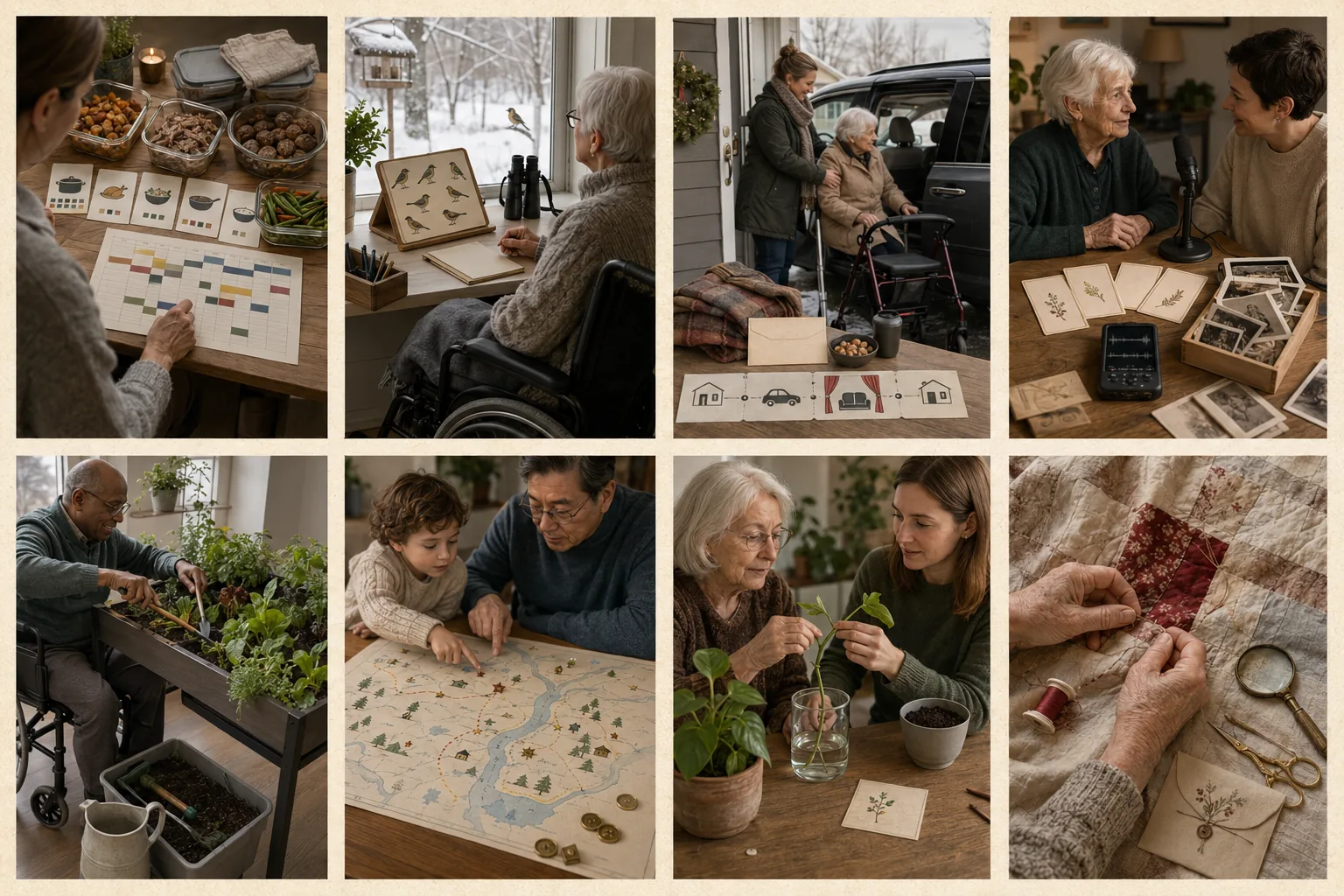
Choose a daytime performance with the grandparent, then arrange door-to-door transport, suitable seating, weather protection, a rest plan, and an early meal if wanted. Carry the tickets and logistics yourself while leaving the grandparent in control of pace and conversation.
See fit and tradeoffs →Invite the grandparent to choose three themes, then record three short conversations on separate days with a simple microphone and clear consent. Edit lightly for audibility, add a written index and transcript, and return both the raw and finished files to the grandparent.
See fit and tradeoffs →Ask whether one worn blanket, garment, bag, or soft object may be assessed, then agree on visible, invisible, or stabilizing repair before work begins. Use an appropriate textile repairer when the material, construction, or emotional value exceeds your skill.
See fit and tradeoffs →
Build the date around the partner's preferred light, sound, crowd level, food, movement, communication, and duration, then offer two activity options. Include a planned early exit and a home version using the same central pleasure so changing course does not feel like failure.
See fit and tradeoffs →Each partner proposes two beginner practices, then together choose one four-session course with transparent dates, materials, access, and cancellation terms. Divide transport, practice, and scheduling work before enrollment so the gift does not make one partner the project manager.
See fit and tradeoffs →Agree on one laundry category, pickup or in-home boundaries, detergent, water temperature, folding standard, and a weekly handoff time for four weeks. The helper completes washing, drying, folding, and return without requiring the parents to sort conversation, refreshments, or gratitude.
See fit and tradeoffs →Ask the parent to choose one administrative cluster, then provide a quiet hour of childcare, meal coverage, note-taking, scanning, or hold-time support while they remain the decision-maker. End by returning originals, deleting any temporary files, and writing only the next actions the parent requests.
See fit and tradeoffs →Invite each willing household branch to nominate one manageable dish or food memory, then let the family choose two to make side by side on a neutral date. Provide ingredients, separate work areas, and blank cards for a new combined variation that nobody is required to call traditional.
See fit and tradeoffs →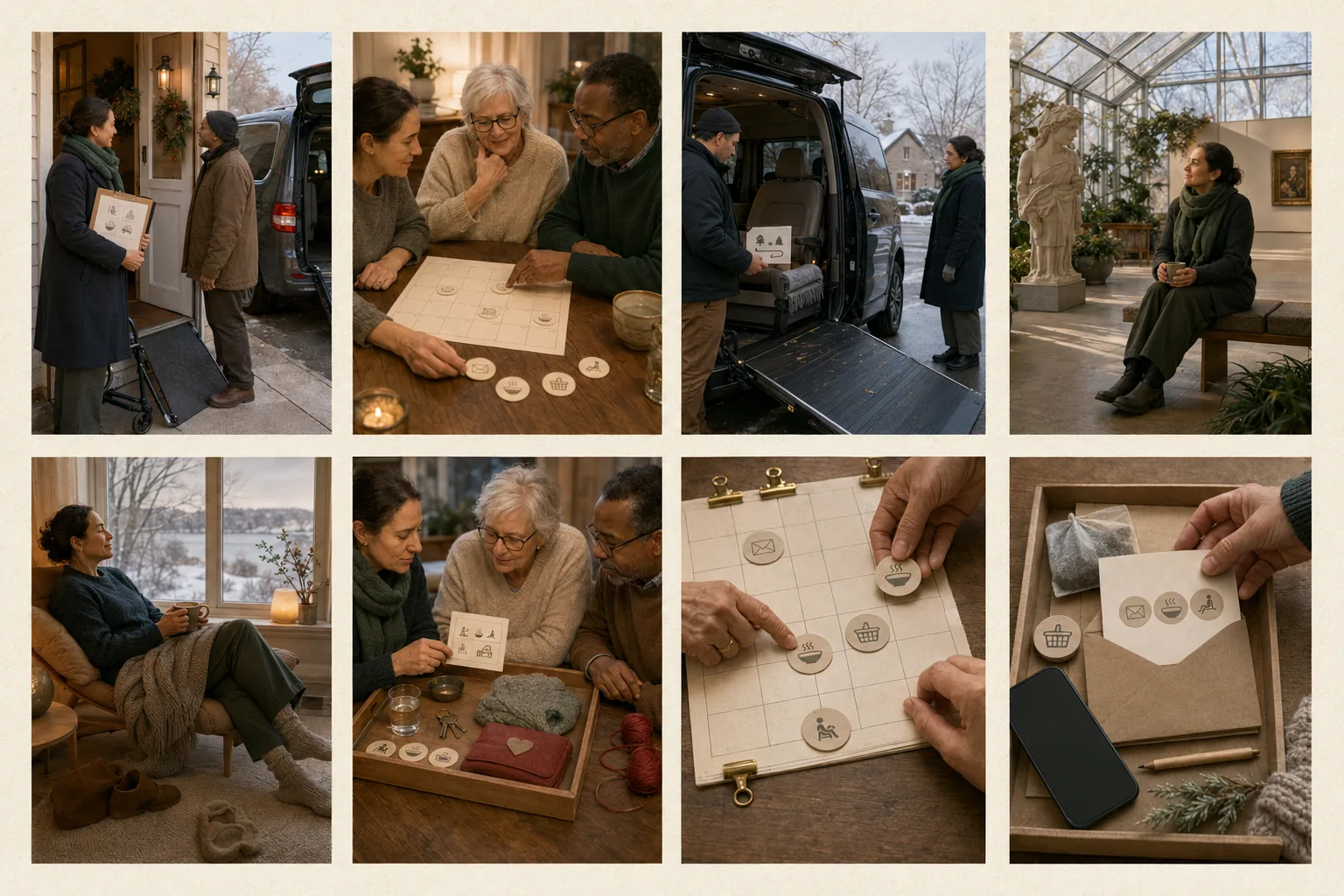
Ask the caregiver what length and kind of time away would restore them, then arrange trusted care coverage, transport, reservations, and a backup plan before offering the date. Keep the outing cancellable and useful even if it becomes a nap elsewhere, a quiet meal, or time alone.
See fit and tradeoffs →Privately ask whether there are two or three dates when a meal, message, errand, company, or no contact would be useful, then record only the preferences they choose to share. Schedule your own reminders and send a brief confirmation before each date so the person can change or cancel the plan without explanation.
See fit and tradeoffs →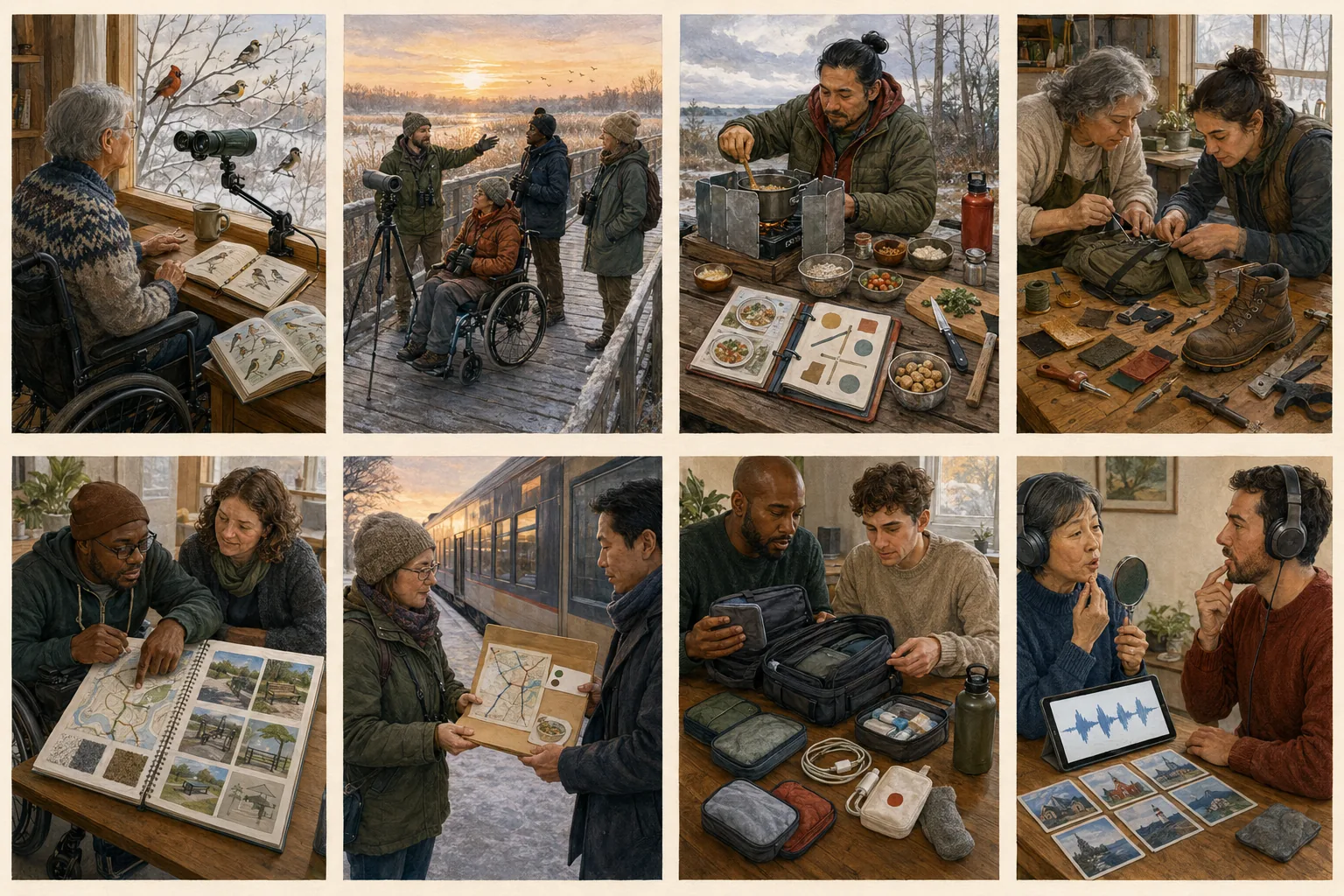
Reserve a small-group bird walk led by a local naturalist and include transport, a warm drink, and binocular borrowing if offered. Put a weather-backup date and the expected distance, terrain, and duration directly in the gift note.
See fit and tradeoffs →Research six nearby nature routes using official access information and record surface, grade, distance, benches, restrooms, parking, shade, noise, and a weather backup for each. Deliver the routes as a phone-friendly document with direct source links and a short option beside every longer outing.
See fit and tradeoffs →Plan a same-day rail trip with a flexible departure window, one destination activity, a meal budget, and an earlier return option. Include current timetable links, station access notes, reservation details, and a paper itinerary that leaves unstructured time.
See fit and tradeoffs →Spend one agreed hour mapping what the recipient actually carries, what repeatedly goes missing, and which items cause security, weight, or access friction. Photograph the final layout, label its zones, and make a replace-only list rather than buying a premade travel set.
See fit and tradeoffs →Arrange a live lesson with a qualified language teacher focused on names, greetings, transit terms, dietary needs, and polite repair phrases for one planned destination. Ask for a short audio recap recorded with the teacher's consent so the recipient can practice accurately.
See fit and tradeoffs →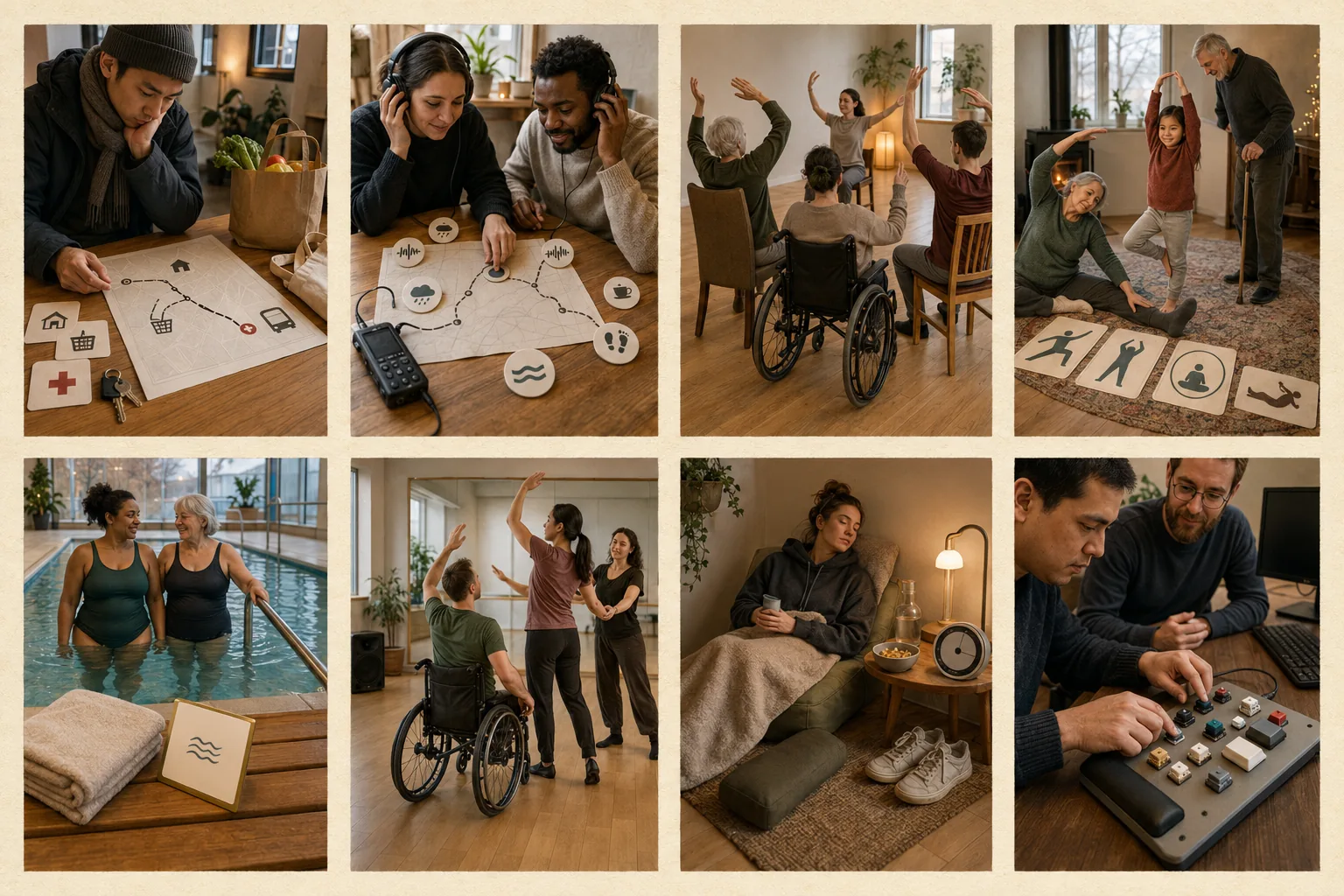
Build a phone-friendly map of two grocery options, one simple prepared-food stop, a pharmacy, and a quiet place to sit near the recipient's confirmed accommodation. Add current opening-hour links, step-free access notes where available, a short first-meal list, and a backup for late arrival.
See fit and tradeoffs →Pay for a short series of live chair-based movement sessions led by a qualified instructor who offers choices rather than performance goals. Arrange the first date, confirm the chair and room setup, and include an easy cancellation path if the recipient's energy changes.
See fit and tradeoffs →Cover several admissions to a warm-water or accessible community pool and offer to accompany the recipient at their chosen pace. Research quiet hours, water depth, entry method, locker setup, and a dry-land alternative before making the invitation.
See fit and tradeoffs →Arrange one introductory dance session whose teacher explicitly supports seated, standing, low-impact, and choose-your-own-level participation. Confirm the music style, room access, class size, rest options, and whether the giver may attend as a companion.
See fit and tradeoffs →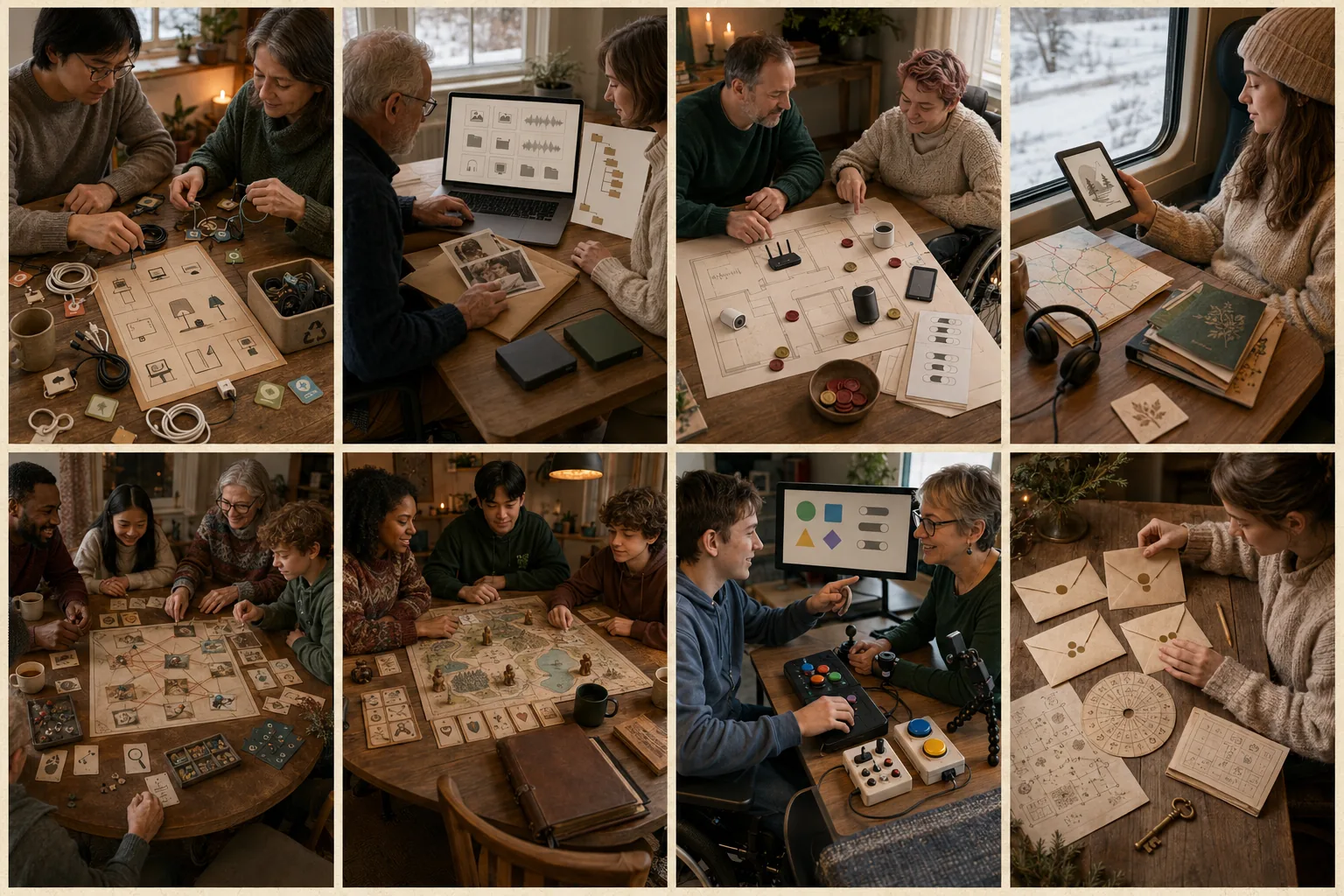
Review one agreed category of household technology, document what is connected, who administers it, what data it collects, and where official privacy controls are found. Leave every change for the owner to approve, record, and test, then provide a short list of unresolved questions rather than a false security score.
See fit and tradeoffs →Curate a small offline folder of legally available essays, public-domain texts, official maps, and library-borrowing links about one destination or route. Add a one-page reading order that distinguishes local voices, historical context, practical information, and material that may now be outdated.
See fit and tradeoffs →Reserve a low-pressure session at a legitimate community gaming lab, library, or accessibility group where the player can borrow and compare several controller styles during one familiar cooperative game. Treat it as a social trial night, not an assessment or purchase appointment.
See fit and tradeoffs →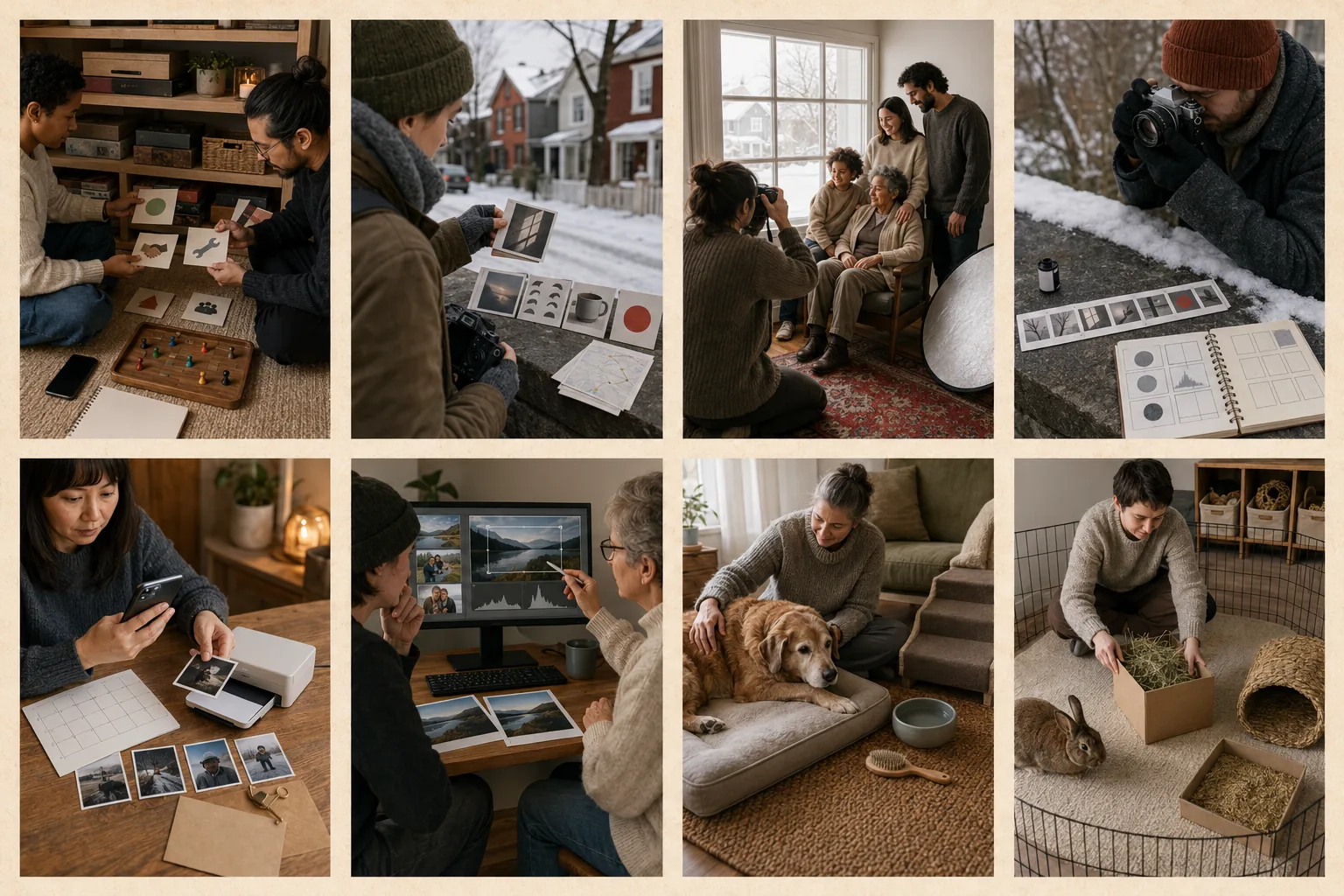
Spend a day with the owner photographing boxes, recording player counts and play times from the packaging, and marking keep, lend, repair, learn, or release decisions they make. Deliver a searchable private list and create one reachable shelf of games the household actually wants to play next.
See fit and tradeoffs →Book a one-to-one lesson using a small folder of the recipient's own photographs and the software or device they already use. Ask the instructor to cover selection, basic tonal and color adjustments, nondestructive workflow, export, and a repeatable backup step rather than dramatic presets.
See fit and tradeoffs →
Register the recipient for a reputable pet first-aid course taught within a clearly stated educational scope and suitable for their animal species. Include the class date, duration, format, accessibility details, and a note that emergencies still require veterinary care.
See fit and tradeoffs →Research a half-day outing with current pet rules, route length, surface, shade, water, waste disposal, parking, quiet escape points, and one weather backup. Include a simple schedule with generous rest and a human-only alternative if the animal is better left at home that day.
See fit and tradeoffs →Book a fit-and-comfort assessment with a qualified bicycle professional who will inspect the existing bicycle, observe the rider, and explain reversible adjustments before recommending new parts. Include a short follow-up after several rides and make clear that the recipient chooses which changes to accept.
See fit and tradeoffs →Reserve one nearby established campsite and plan a low-stakes test using borrowed or already-owned gear, a simple meal, an arrival-before-dark rule, and an easy route home. Measure the actual vehicle and sleeping setup in advance, then agree on ventilation, weather limits, campground rules, and a no-shame cancellation point.
See fit and tradeoffs →
Plan attendance at a public observatory or astronomy-club night with current event details, transport, weather backup, warm layers already owned, and a simple red-light-safe observation card if the organizer permits it. Choose three visible targets from the host's published program and explain that clouds may change the entire evening.
See fit and tradeoffs →Choose four established citizen-science activities from reputable institutions, one per season, and place their official instructions, dates, training, data policy, and accessible participation options in a shared calendar. Offer to join the first observation and add a clear exit if the project no longer fits the recipient's time or values.
See fit and tradeoffs →Arrange a consultation with a qualified conservator or collection-care professional focused on one defined material or storage problem the owner has identified. Request written priorities that distinguish immediate risks, low-cost housekeeping, suitable enclosures, specialist treatment, and objects that should simply be left alone.
See fit and tradeoffs →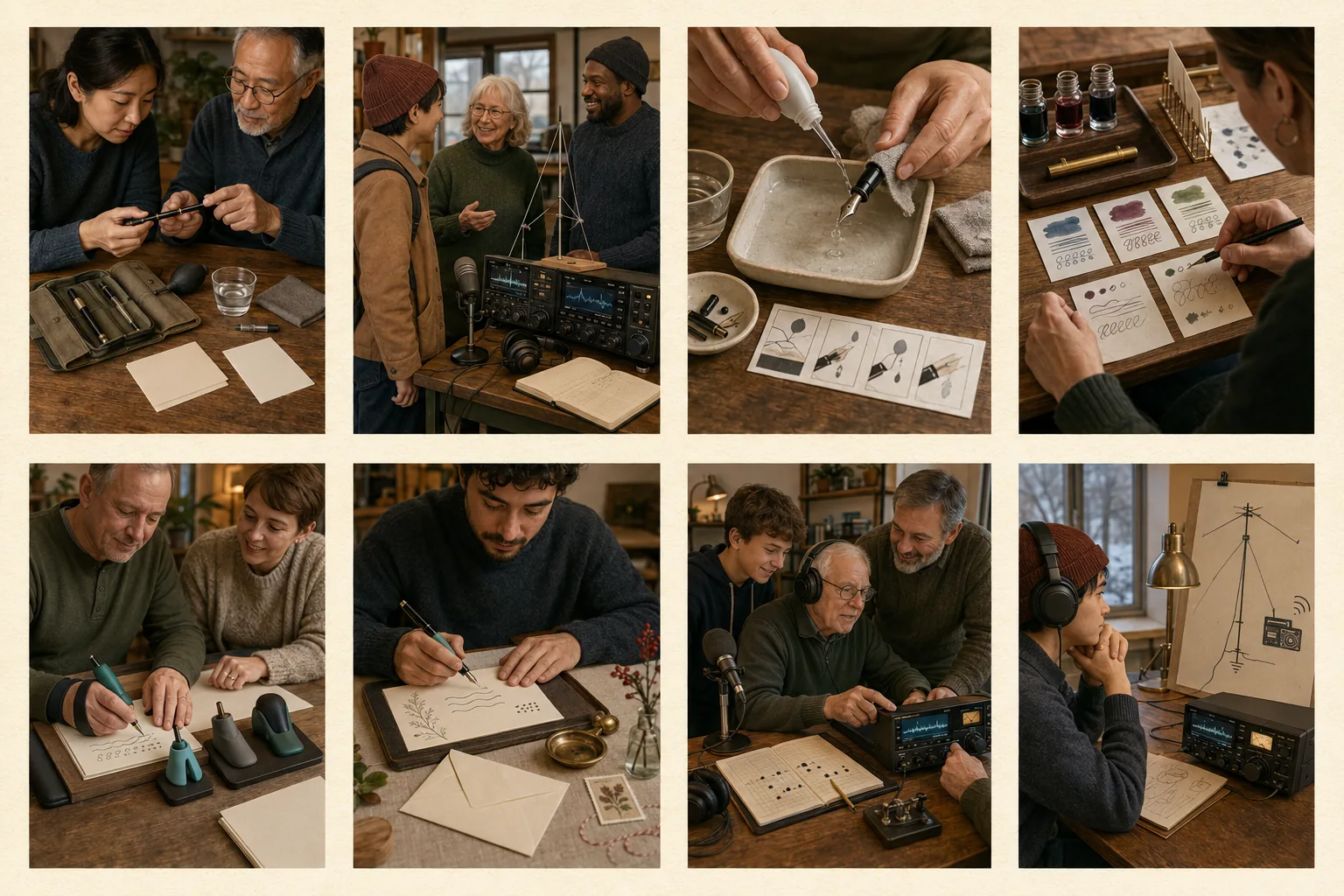
Arrange a visit to a reputable local amateur radio club's public demonstration, open house, or beginner session where licensed operators explain listening, operating rules, equipment, and the path to licensing. Include event details, transport, a plain-language glossary, and no expectation that the recipient purchase or transmit with equipment.
See fit and tradeoffs →
Write one page naming a decision, piece of judgment, or quiet act that changed the work, and describe its effect without disclosing confidential details. Give the original privately and, with permission, send a shorter version to someone who can formally recognize the contribution.
See fit and tradeoffs →Ask for the colleague's exact meal, delivery window, dietary needs, and whether company is welcome, then handle ordering or preparation. Deliver it with utensils and a cleanup plan, and protect the break by taking one agreed minor task or message window.
See fit and tradeoffs →With the organizer's approval, attend one routine meeting for the colleague and use an agreed template for decisions, owners, deadlines, and unresolved questions. Send the brief immediately afterward and handle only the follow-up the colleague explicitly delegates.
See fit and tradeoffs →Ask the colleague which one shared-desk friction matters most, then spend an hour labeling communal cables, clearing expired supplies, documenting equipment, or creating a portable setup tray. Keep personal belongings untouched and obtain facilities approval before changing fixtures or disposal routines.
See fit and tradeoffs →Interview willing teammates about where they learned a recurring process and build a private map linking questions, documents, and named expertise. Ask the recipient to correct their entry and explicitly mark what should become shared documentation rather than permanent invisible labor.
See fit and tradeoffs →Research a short accessible route around three ordinary sites near work and prepare one verified story for each without turning the walk into a lecture. Invite the colleague for a defined lunch break, include a weather backup, and end with their preferred simple food or drink.
See fit and tradeoffs →With school approval, ask the teacher to set aside repairable books and agree on a simple triage system for mend, replace, or retire. Bring archival-safe materials, complete only appropriate repairs, clean the workspace, and return an inventory that does not assign the teacher more work.
See fit and tradeoffs →
Ask the teacher whether a guest reading would genuinely help, then obtain school approval and let the teacher choose the date, text, length, and learning connection. Prepare the book, accessibility supports, arrival process, and one simple follow-up question without asking the teacher to host or improvise.
See fit and tradeoffs →Ask the teacher for a photographed end-state and divide approved volunteers among surfaces, reusable decorations, recycling, food removal, furniture, and take-home items. Complete the reset after the event, follow school sanitation rules, and leave the room ready for the next instructional day.
See fit and tradeoffs →Coordinate through the workplace to identify the real meal break, headcount, dietary needs, storage, and delivery security for the overnight team. Provide clearly labeled food in portions that can be eaten across staggered breaks, plus a plan for leftovers and containers.
See fit and tradeoffs →Ask through an appropriate channel whether the worker may accept a modest lunch and let them choose takeout, company, timing, or a transferable local meal credit. Handle ordering, travel, gratuity, and cancellation without extending the break beyond workplace rules.
See fit and tradeoffs →Ask the host for one final written list with exact substitutions, budget, destinations, and a firm return time. Complete the run, send only necessary questions, put every item in its agreed place, and remove receipts or reimbursements according to the plan.
See fit and tradeoffs →
Agree before the gathering on a morning arrival window and a bounded kitchen reset covering dishes, counters, labeled leftovers, recycling, and floor. Bring breakfast, work quietly from the host's instructions, and leave without requiring them to retell or evaluate the event.
See fit and tradeoffs →Before the meal, agree which washable napkins, cloths, aprons, or uncomplicated table linens the host wants handed off and photograph care labels with permission. Collect them in labeled bags, use the approved process or cleaner, then return each category folded or rolled exactly as requested.
See fit and tradeoffs →Choose a real January date and arrange a restaurant meal, delivered supper, or gathering in another home where the usual host has no planning, cooking, transport, or cleanup role. Make the invitation explicit about duration, cost, access, and whether they may bring a partner or care responsibility.
See fit and tradeoffs →Walk the arrival route with the host and, when appropriate, the invited guest, checking parking or drop-off, steps, light, door width, coats, seating, restroom, food, quiet space, and departure. Record only agreed adjustments and help implement the low-risk changes the host and guest choose.
See fit and tradeoffs →Before the event, agree on who may be photographed, what should never be captured, and whether guests can opt out visibly but discreetly. Afterward, remove duplicates and unflattering near-misses, caption a small private set, and deliver files without posting or creating an account.
See fit and tradeoffs →Cook the host's chosen recipe together once, weighing the actual finished yield and recording pan size, active time, holding time, serving tool, and realistic portions. Produce a clear scaling sheet for several guest ranges and mark which steps should not simply be multiplied.
See fit and tradeoffs →Agree in writing on which walkway, steps, vehicle edge, or entry must be cleared, the trigger depth or local requirement, permitted materials, and who handles extreme conditions. Arrange qualified help or complete the safe low-risk work, then send one completion message without implying surveillance of the home.
See fit and tradeoffs →
Create a dated checklist for only the tasks the neighbor requests, such as moving bins, collecting ordinary mail, or receiving named parcels in an agreed location. Use one daily completion message, preserve privacy, and hand everything back at a fixed time after the trip.
See fit and tradeoffs →Walk the public arrival route with the neighbor after dark and identify one agreed friction such as an unreadable number, failed bulb, obscured step edge, or confusing bell label. Replace only simple renter-approved items within your skill, or arrange qualified help for wiring, fixtures, ladders, or structural changes.
See fit and tradeoffs →Ask the neighbor to choose one or two eligible hand tools and photograph each item, condition, and edge before accepting it. Use an appropriate local sharpening service, transport the tools safely, and return them labeled with care and storage guidance.
See fit and tradeoffs →Walk the plot together and mark the exact beds, watering method, harvest permissions, gate procedure, and dates on a simple diagram. Follow garden rules, record each visit, and leave produce exactly where the gardener requests rather than making independent cultivation decisions.
See fit and tradeoffs →Help the neighbor choose one eligible object, register for a local repair event, gather model details and parts, and arrange door-to-door transport. Attend as a note-taker or extra pair of hands, while making clear that assessment may end with responsible recycling rather than repair.
See fit and tradeoffs →Ask the new neighbor which one room needs to function first, then offer a bounded setup covering bed, bathroom, lighting, chargers, water, or an easy meal using their own belongings. Follow their labels, stop at the agreed time, remove packing debris through approved channels, and leave every unopened box unopened.
See fit and tradeoffs →Choose one shelf-stable breakfast element available or shippable in both places and agree on a twenty-minute weekend window across time zones. Send the parcel with a simple place card, then eat together by call or exchange one photo and voice note asynchronously.
See fit and tradeoffs →Choose four broad seasonal windows and exchange one voice note from a familiar route in each, describing sound, weather, one change, and one ordinary thought. Keep every note under five minutes, allow missed seasons without apology, and save files only if both friends want an archive.
See fit and tradeoffs →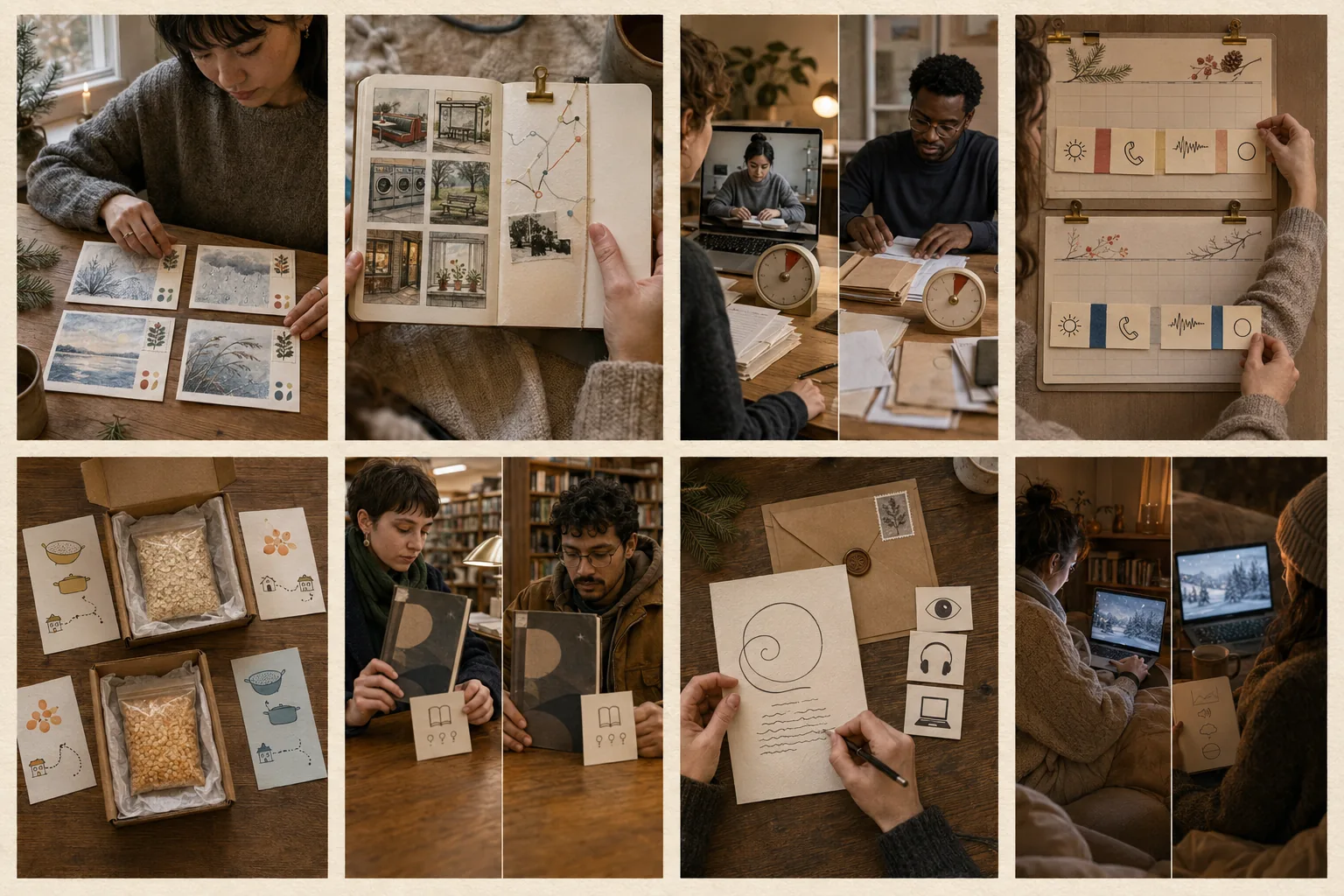
Offer one scheduled hour in which the friend chooses a safe bounded task, states the first step, and works with a quiet video, audio, or text presence. Check in only at agreed intervals, celebrate stopping as well as finishing, and keep all documents and screens private.
See fit and tradeoffs →Compare both calendars and time zones, then offer four short call windows across the next season with each person's local time written explicitly. Put only accepted windows on shared calendars, include a no-explanation skip phrase, and choose an asynchronous backup for difficult weeks.
See fit and tradeoffs →Each friend chooses one shelf-stable nonbranded staple they genuinely use and writes two ordinary ways it appears in their kitchen. Check restrictions, mail compact quantities, and schedule an optional text or audio exchange after both have tried the other's routine.
See fit and tradeoffs →Search both public-library catalogs for one mutually interesting book, film, recording, or magazine issue and place separate holds only after agreement. Choose a flexible discussion window and exchange three questions that work even if one person finishes only part of the material.
See fit and tradeoffs →Choose one legally accessible film both people already can watch and create a private shared notebook with time-stamped prompts for image, line, sound, memory, and disagreement. Each friend watches on their own schedule, adds only what they want, and closes the notebook on a set date.
See fit and tradeoffs →
Sit with the recipient while they identify devices, remove wanted accessories, sign out, back up, and erase data using the manufacturer's or local program's guidance. Transport only approved items to a verified recycler or reuse program and return receipts plus anything rejected.
See fit and tradeoffs →Ask the recipient to choose one pair and agree on the exact repair, appearance, comfort priorities, maximum scope, and whether substitution is allowed. Photograph condition, use a qualified repair shop, handle transport, and return the shoes with care instructions and original parts when requested.
See fit and tradeoffs →Provide a private worksheet and sit beside the recipient while they identify renewals from their own statements, email, or device without sharing credentials. They classify each as keep, compare, cancel, or investigate, and you handle notes, calendars, or customer-service wait time only under their direct control.
See fit and tradeoffs →Ask the recipient to choose one safe reachable window zone and agree on glass, track, sill, screen, curtains, furniture movement, and preferred products. Complete only the approved low-risk work or hire an insured professional, then return furniture and wash or remove every cloth and tool.
See fit and tradeoffs →Offer a short menu of local classes selected from interests the recipient has actually expressed and let them choose one or decline all. Register only after confirming dates, materials, transport, accessibility, cancellation, and whether the giver attends or simply handles logistics.
See fit and tradeoffs →Let the recipient choose one nonlegal everyday document and specify whether they want reading aloud, large print, clean headings, form navigation, scanning, or a plain-language summary for their own review. Work beside them, preserve the original, label every interpretation, and delete temporary copies at the end.
See fit and tradeoffs →Agree on a coded recipient list, wrapping style, reusable materials, concealment, fragile items, and a defined batch before anything changes hands. Wrap at the recipient's home or transport securely, label every parcel clearly, return leftovers sorted, and delete the code key after handoff.
See fit and tradeoffs →Sit with the recipient while they sort only items they own into return, exchange, donate, recycle, and keep, then verify deadlines and destination rules. Handle packing, transport, receipts, and rejected items according to the written plan while leaving every final decision with the owner.
See fit and tradeoffs →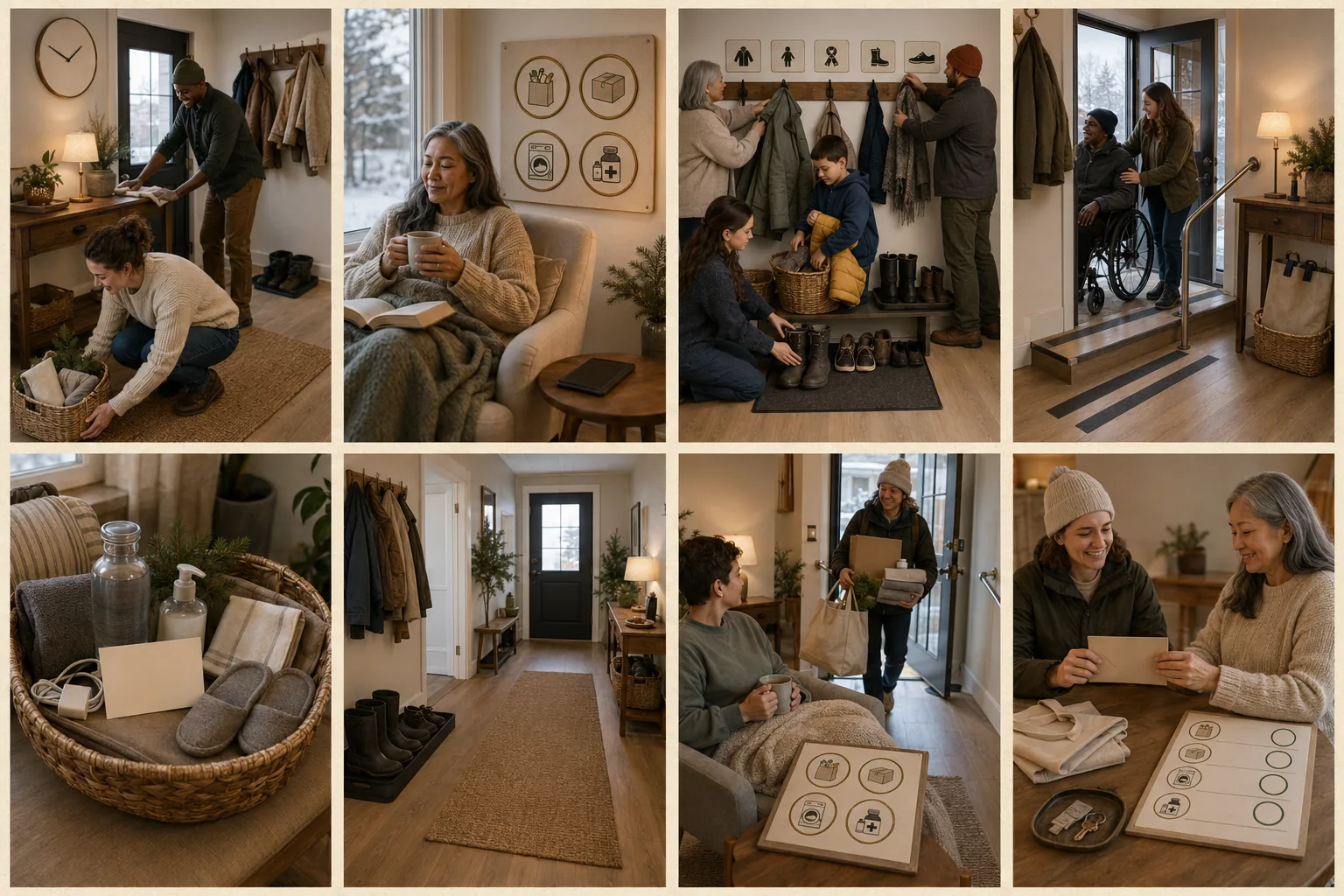
Ask the resident to define a two-hour scope covering only coats, shoes, bags, lighting, guest directions, and a clear route through the entry. Work beside them to relocate approved items temporarily, label the storage destination, clean the cleared surfaces, and stop at the agreed time.
See fit and tradeoffs →Choose a real date and ask the recipient which recurring tasks must disappear for six hours, then assign groceries, meals, care coverage, pet needs, transport, and urgent communication to willing qualified people. The recipient decides whether to stay home, go out, see someone, or do nothing, with every option treated as complete.
See fit and tradeoffs →
Plan a simple meal with six-minute drawing rounds in which each person looks at a partner rather than the paper. Use broad dark markers, large sheets, and consent-based pairings, then let every subject choose whether their portraits are displayed, taken home, recycled, or kept private. End with one ordinary group drawing made together.
See fit and tradeoffs →Choose a museum the recipient actually wants to visit and design a short route with three works, nearby seating, allowed dry drawing tools, rest points, and a quiet meal or drink afterward. At each work, offer one optional prompt about shape, negative space, or gesture, and leave enough time for looking without producing a finished drawing.
See fit and tradeoffs →
Begin with one question the recipient genuinely asks, such as how ordinary people stored food or how clothing signaled work, then identify four objects in one current collection that offer different evidence. Prepare brief source notes, gallery locations, uncertainties, and a quiet discussion stop, while leaving room for the recipient to reject your interpretation.
See fit and tradeoffs →Arrange a compensated small-group or private session with a practitioner who publicly offers teaching or demonstrations in their own tradition. Ask the maker to define what may be observed, handled, photographed, or attempted, and include time for the history, contemporary practice, labor, and proper care of the work rather than promising a take-home replica.
See fit and tradeoffs →Choose a legitimate public open-house program or bookable building tour and create a route of no more than three sites with verified entry rules, travel time, rest, weather backup, and one meal. Add a small field card for plan, threshold, material, and reuse observations, but do not turn private residences into uninvited sightseeing stops.
See fit and tradeoffs →Research four publicly viewable works along a safe route, confirm artist names and official context, then record short original audio stops describing what is visible, what the source says, and one open question. Supply a map, transcript, image descriptions, route conditions, and a stationary listening version so the gift does not depend on walking or mobile data.
See fit and tradeoffs →Let the recipient choose an established public festival, then handle verified tickets if required, transportation, a two-event maximum schedule, food planning, weather, seating, and a clear early-exit option. Read the organizer's own context in advance and treat the day as participation in a community event, not a costume or sampling challenge.
See fit and tradeoffs →Choose an inclusive beginner-friendly social dance event the recipient approves, confirm the lesson format and consent norms, and arrange transport, footwear guidance, water, seating, and an agreed departure time. Attend as a supportive companion without making the recipient dance with you or stay for the full social.
See fit and tradeoffs →
Arrange an official theatre, concert hall, or community-stage tour that focuses on scenery, props, lighting, sound, wardrobe workflow, and the workers behind them. Pair it with a performance only if the recipient wants one, and prepare three practical questions about training, collaboration, and safety rather than asking staff for informal job access.
See fit and tradeoffs →Find a non-audition or explicitly open rehearsal that welcomes prospective members, then confirm repertoire, voice-part flexibility, music format, dues context, and whether observing without singing is acceptable. Attend or arrange transport, and make the gift only the guest visit so the recipient decides privately whether to return.
See fit and tradeoffs →Pay for four beginner or level-appropriate sessions taught by a qualified Deaf instructor or an established community program, selected by the recipient. Center the series on real conversation goals, such as greetings, family routines, or workplace introductions, while including cultural context and a clear path for continued learning if the recipient chooses.
See fit and tradeoffs →Using licensed, public-domain, or instructor-approved audio, choose twelve short clips on one subject the recipient already loves. For each, provide a transcript, translation or glossary, three playback speeds if legitimately available, and a practice sequence of listen, mark rhythm, shadow softly, record privately, and compare without scoring accent.
See fit and tradeoffs →Choose a public market where the target language is genuinely used and welcome, prepare eight respectful phrases for greeting, asking about one ingredient, quantity, price, and thanks, then practice privately before visiting at a non-rush time. The fluent companion should step in only when invited, buy something actually wanted, and debrief away from workers.
See fit and tradeoffs →
Work with the recipient on one video under ten minutes: create an accurate time-coded transcript, identify speakers and meaningful sound, edit readable captions, and prepare one subtitle language only with a qualified translator or fluent reviewer. Deliver editable files and a short style note rather than burning unchangeable text into the only master copy.
See fit and tradeoffs →Invite willing speakers to a simple meal with two timed conversation halves, one in each language, and agree on correction preferences before starting. Prepare accessible topic cards about ordinary life, give equal time and status to both languages, cover the food, and end before anyone becomes a host, interpreter, or unpaid teacher for the entire evening.
See fit and tradeoffs →Pay a suitable independent editor for one clearly bounded essay and a written response covering structure, voice, evidence, reader questions, and two revision priorities, followed by a scheduled conversation. The writer chooses the draft, goals, identity context, and whether line editing is included, and retains all authorship and publication decisions.
See fit and tradeoffs →Ask what four uninterrupted hours would require, then take responsibility for the agreed childcare, elder support, meal, transport, household questions, and emergency contact plan. Reserve the recipient's preferred home or outside workspace, protect the boundary without asking for pages produced, and complete the handback tasks before the morning ends.
See fit and tradeoffs →Build a compact digital kit for writing one five-minute audio scene: a two-character constraint, a location heard but never described, a turning point card, a script template, a rights-safe sound list, and an editing checklist. Let the teen write alone or with friends, record only consenting voices, and treat a script without a recording as a complete result.
See fit and tradeoffs →
Host a two-hour opt-in session to assemble a one-page family update from short contributions such as one ordinary change, one photo with consent, one recommendation, and one date ahead. Edit for clarity without making every household sound cheerful or equal, circulate a proof, and send only to the recipients named by contributors.
See fit and tradeoffs →Let the recipient select a poem and verify permission to reproduce it, then create a four-week private practice path with meaning notes from reliable sources, line groupings, first-letter cues, optional audio by an authorized reader, and gentle recall dates. Include a no-recitation option and treat partial familiarity as success.
See fit and tradeoffs →With the writer's permission, invite a small number of willing readers for one draft under an agreed page or time limit, assign roles without assumptions, provide accessible scripts, read stage directions neutrally, and gather only the feedback questions the writer requests. Cover simple food and end with all scripts returned or deleted.
See fit and tradeoffs →Let the teen choose a qualified coach and an age-appropriate monologue they are permitted to use, then fund one session focused on text, intention, breath, pacing, and grounded performance choices. With consent, create a simple private rehearsal recording or annotated script for the teen, not a public audition reel or guaranteed casting package.
See fit and tradeoffs →Choose a reputable true-beginner workshop that explicitly permits passing, observation, and low-pressure participation, then confirm group size, exercise style, access, and content norms with the recipient before booking. Arrange transport and a quiet debrief, and make continuing classes entirely their decision.
See fit and tradeoffs →Choose a one-minute rights-cleared or family-made silent clip and gather safe household materials for footsteps, weather, doors, fabric, and one invented sound. Assign recording, performing, cueing, and listening roles by preference, record multiple takes, and compare how changing materials alters the scene without requiring anyone to appear on camera.
See fit and tradeoffs →
Let the poet select a legitimate open mic, then handle current signup details, transport, an optional timed rehearsal, printed or device-ready text, water, audience seating, and an agreed exit. Attend as the supportive person they request, record only with permission from the poet and venue, and make performing entirely reversible until their name is called.
See fit and tradeoffs →With the dancer's permission, document one short phrase through a combination of their chosen words, floor-path drawing, rhythm marks, and selected still shapes, then assemble the material into a compact visual score. Credit the dancer as choreographer, label the notation as interpretive rather than universal, and let them control filming, visibility, and future sharing.
See fit and tradeoffs →Let the recipient name one narrow recurring friction, such as getting out the door for a weekly appointment, then observe or reconstruct the sequence with consent. Map actions, waits, information, objects, people, and failure points on one page, identify the smallest reversible experiment, and help run it once without reorganizing the recipient's life.
See fit and tradeoffs →Co-design a reusable invitation template that clearly separates date, time zone, location, access, cost, food, scent or sound conditions, children, support people, RSVP, privacy, and how to decline. Provide plain-text, large-print, mobile, and printable versions, then test one sample invitation with keyboard navigation and a reader unfamiliar with the event.
See fit and tradeoffs →Hire a librarian, educator, or subject specialist to turn one recipient-chosen question into a six-week path with one accessible overview, two contrasting sources, one primary source or direct observation, one practical exercise, and one conversation prompt per week. Include source limitations, access routes, and a lighter three-week option without quizzes or a certificate claim.
See fit and tradeoffs →
Let the recipient choose three legitimate public lectures or talks across several months, then handle registration, transport, access requests, and a brief post-event meal or remote call. Before each, provide only a short speaker and topic note; afterward, use two open questions and preserve the option to skip any session without replacing it with homework.
See fit and tradeoffs →Choose three harmless sample claims from advertising, old viral images, or public information, then practice a repeatable sequence: pause, identify the original claim, inspect source and date, seek independent evidence, check image context, and state what remains unknown. Give each person a role and end by writing one household sharing rule rather than declaring a winner.
See fit and tradeoffs →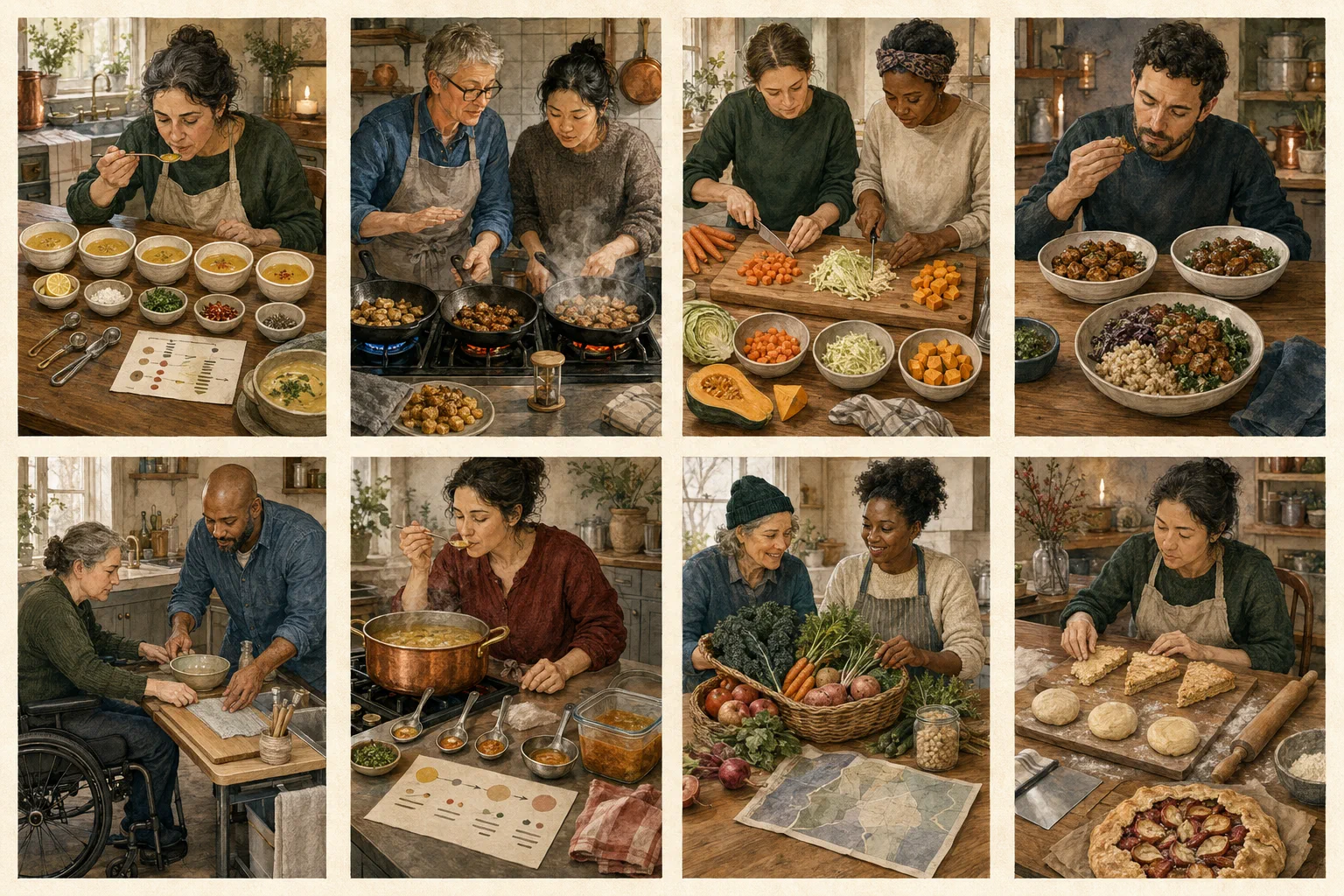
Cook one neutral base dish, divide it into small bowls, and adjust salt, acidity, sweetness, bitterness, and heat one variable at a time. Record the recipient's preferred balance and finish by seasoning the shared supper together.
See fit and tradeoffs →Arrange a one-on-one lesson using the recipient's own stovetop and skillet to compare preheating, pan crowding, moisture, and recovery time. Cook one familiar ingredient in three small batches and leave a visual cue card based on what actually happened.
See fit and tradeoffs →Book a private lesson that uses the recipient's own comfortable knife to practice a stable board, guiding hand, and three cuts on vegetables they regularly cook. Turn every practice piece into a labeled soup, roast, or stir-fry component.
See fit and tradeoffs →Create a guided kitchen session comparing two preparation methods for one familiar plant protein, such as pressing and crumbling or soaking and roasting. Use the same seasoning, record texture differences, and build both results into a complete meal.
See fit and tradeoffs →Arrange a consent-led session with an appropriate occupational-therapy, rehabilitation, or adaptive-kitchen professional to observe one real meal task and suggest a shorter, safer workflow. Fund only the changes the recipient chooses after trying them.
See fit and tradeoffs →Make one forgiving seasonal soup and pause at three stages to taste for body, salt, acidity, aroma, and temperature. Let the recipient choose each adjustment, note what changed, and package the finished soup with its actual final measurements.
See fit and tradeoffs →Visit one local market together with a fixed basket budget, choose a manageable set of seasonal ingredients, and cook a two-part meal without buying specialty gear. Include one planned fallback ingredient so imperfect produce availability does not derail the day.
See fit and tradeoffs →
Plan a cool, unhurried morning to make one small batch of laminated dough with a qualified teacher or experienced baker. Mark each fold, rest, and temperature check on a reusable timeline and bake simple shapes that reveal the layers clearly.
See fit and tradeoffs →Make one small cookie dough and divide it into controlled samples that change a single variable such as chill time, portion depth, or baking duration. Taste the labeled results together, then bake the remaining dough using the household's chosen texture.
See fit and tradeoffs →Use an appropriate oven thermometer and a simple test bake to map preheat time, rack differences, and obvious hot zones without altering the appliance. Record observations, recipe-placement notes, and the point at which a qualified appliance professional should be consulted.
See fit and tradeoffs →Choose one familiar baked item and test a single needed substitution in two small controlled versions using reputable recipe guidance. Label every ingredient, compare texture and flavor without judgment, and write the successful method only after the household approves it.
See fit and tradeoffs →Compare three teaspoon-scale batches of one whole spice: untoasted, lightly toasted, and more deeply toasted within safe recipe guidance. Grind each separately, smell them side by side, and use all three in small portions of one familiar dish.
See fit and tradeoffs →
Build one modest granola formula by selecting a base, binder, texture, sweetness, and add-ins from ingredients the household already enjoys. Bake two small sweetness or crunch tests, record the chosen ratio, and package only a realistic two-week quantity.
See fit and tradeoffs →Harvest only ready herbs from plants the recipient owns, then compare one appropriate drying method with one freezer or salt-based method from tested guidance. Label small quantities by herb, date, method, and two intended dishes.
See fit and tradeoffs →Make one small fruit-and-vinegar syrup from a tested refrigerated method, then dilute it three ways with still water, sparkling water, or warm water. Record the recipient's preferred ratio and label storage, ingredients, and a conservative use-by date from the source.
See fit and tradeoffs →Cook one bean variety in two small batches using tested differences in soaking, salting, or cooking method, then compare texture and broth. Turn both batches into planned meals and record the method that best fits the household's equipment and schedule.
See fit and tradeoffs →Bake one tested seeded cracker dough at two thicknesses, cool it completely, and compare snap, serving use, and next-day storage. Record the preferred rolling guide and pack only the amount that remains crisp in the recipient's existing airtight container.
See fit and tradeoffs →Use the recipient's existing brewer to make three small cups that vary only coffee-to-water ratio or grind within the equipment guidance. Compare them without scoring, then write the recipient's chosen measurements, water amount, timing, and an easy half-batch version.
See fit and tradeoffs →Prepare two small cups of a tested cacao-based drink, comparing one whisking or milk choice while keeping sweetness under the recipient's control. Set a defined twenty-minute pause with comfortable seating, water, and no expectation to turn it into a ceremonial performance.
See fit and tradeoffs →Make one small refrigerated citrus cordial from a tested recipe, then test three serving ratios with still, sparkling, and warm water. Write the chosen ratio, ingredient list, storage guidance, and a batch scale for the host's realistic guest count.
See fit and tradeoffs →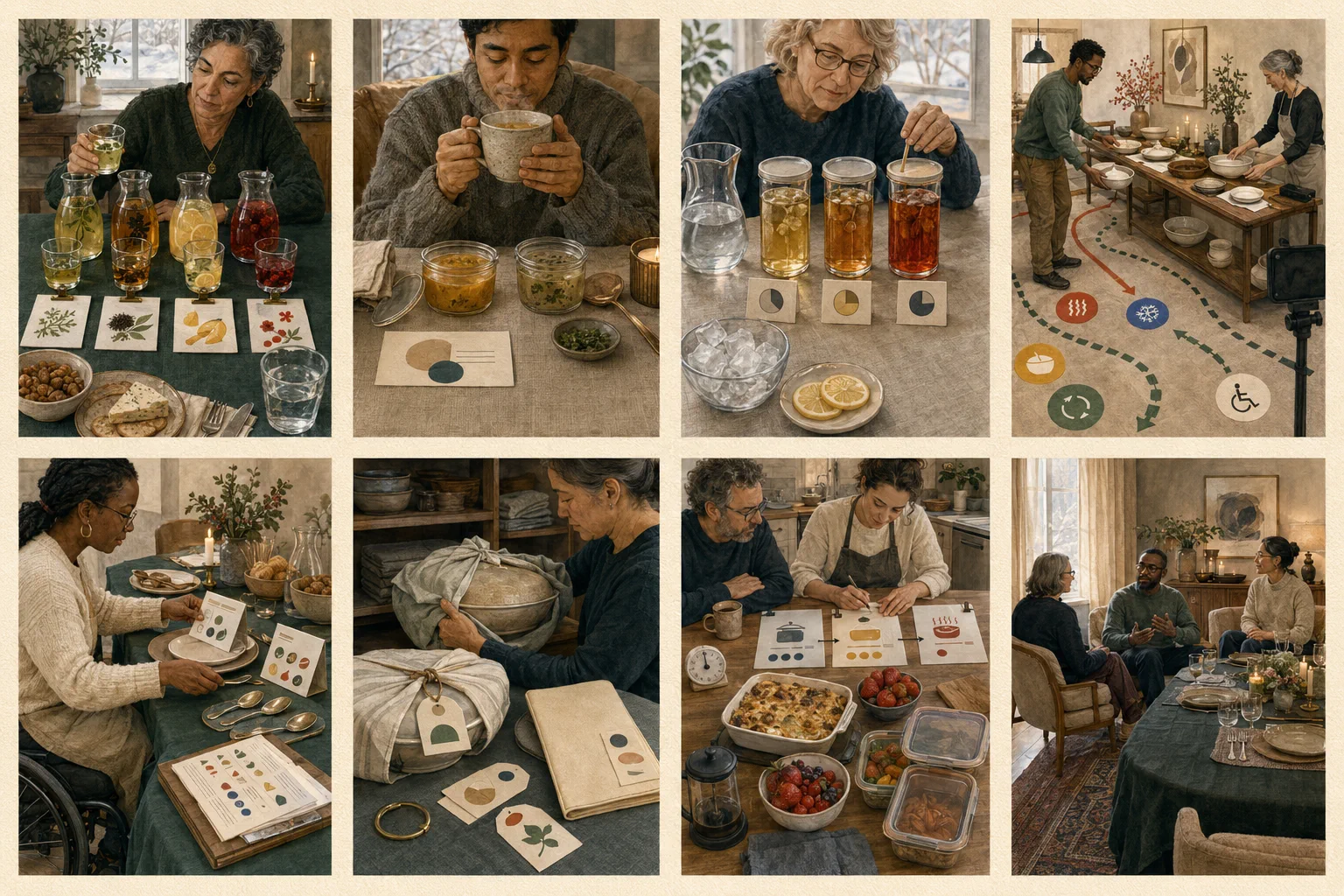
Set up a small blind tasting of four clearly non-alcoholic bitter, botanical, tea-based, or fruit-forward drink styles in tasting portions. Record ingredients, dilution needs, sweetness, accessibility, and the host's chosen occasion without ranking by price or imitation.
See fit and tradeoffs →Prepare two small portions of a tested vegetable or other recipient-approved broth with complete ingredient labels and reheating guidance. Pair them with a specific ten-minute evening pause and one easy garnish option stored separately.
See fit and tradeoffs →Cold-steep one tea the recipient already likes at three tested time points, keeping leaf, water, and temperature constant. Taste small portions, record the preferred strength and dilution, and turn the rest into a right-sized pitcher with a clear refrigerated use window.
See fit and tradeoffs →Walk through one planned meal using empty serving pieces, paper food labels, and the actual table or buffet. Test where hot, cold, heavy, allergen-sensitive, and refill items can move safely, then photograph the agreed layout and assign only necessary helper roles.
See fit and tradeoffs →Run a half-size rehearsal of the host's planned brunch menu, separating work into previous-day, morning, and serve-now tasks. Time oven and refrigerator transitions, test one holding method, and reduce the menu until the host has a realistic quiet period with guests.
See fit and tradeoffs →Test the dining room with two or three people speaking at normal volume, then make reversible changes using existing curtains, upholstered seating, table linens, quieter serving positions, and a reduced background-audio plan. Record which changes the host actually prefers.
See fit and tradeoffs →
Set up a temporary scrape, soak, wash, dry, leftover, and return-home flow using the host's existing sink, bins, towels, and containers. Write short helper roles, identify fragile or hand-wash items, and test the route with one ordinary dinner.
See fit and tradeoffs →Build an accessible shared board that lists meal roles, approximate portions, ingredients, dietary notes, serving needs, arrival temperatures, and whether the contributor wants leftovers returned. Include bring nothing and help on site as equal participation choices.
See fit and tradeoffs →Arrange a consultation around the recipient's existing dwarf citrus plant to review verified identity, light, watering, drainage, seasonal movement, pollination questions, and visible stress. Leave a short observation plan and buy no treatment until the cause is reasonably established.
See fit and tradeoffs →Use the recipient's existing, correctly identified culinary herbs to demonstrate where and how much to harvest for continued growth. Prepare one immediate dish, label any safe cuttings for short storage, and leave a simple plant-specific harvest rhythm.
See fit and tradeoffs →Arrange a qualified plant-health inspection of a small, defined houseplant collection, documenting visible evidence, likely pathways, isolation options, and when laboratory or professional pest support is needed. Purchase treatment only after species, household, and label fit are checked.
See fit and tradeoffs →Observe one defined garden area at several times on a representative day, sketching direct light, reflected heat, structures, tree canopy, and seasonal uncertainty. Produce a simple shade map and a list of questions for local plant guidance rather than prescribing a shopping list.
See fit and tradeoffs →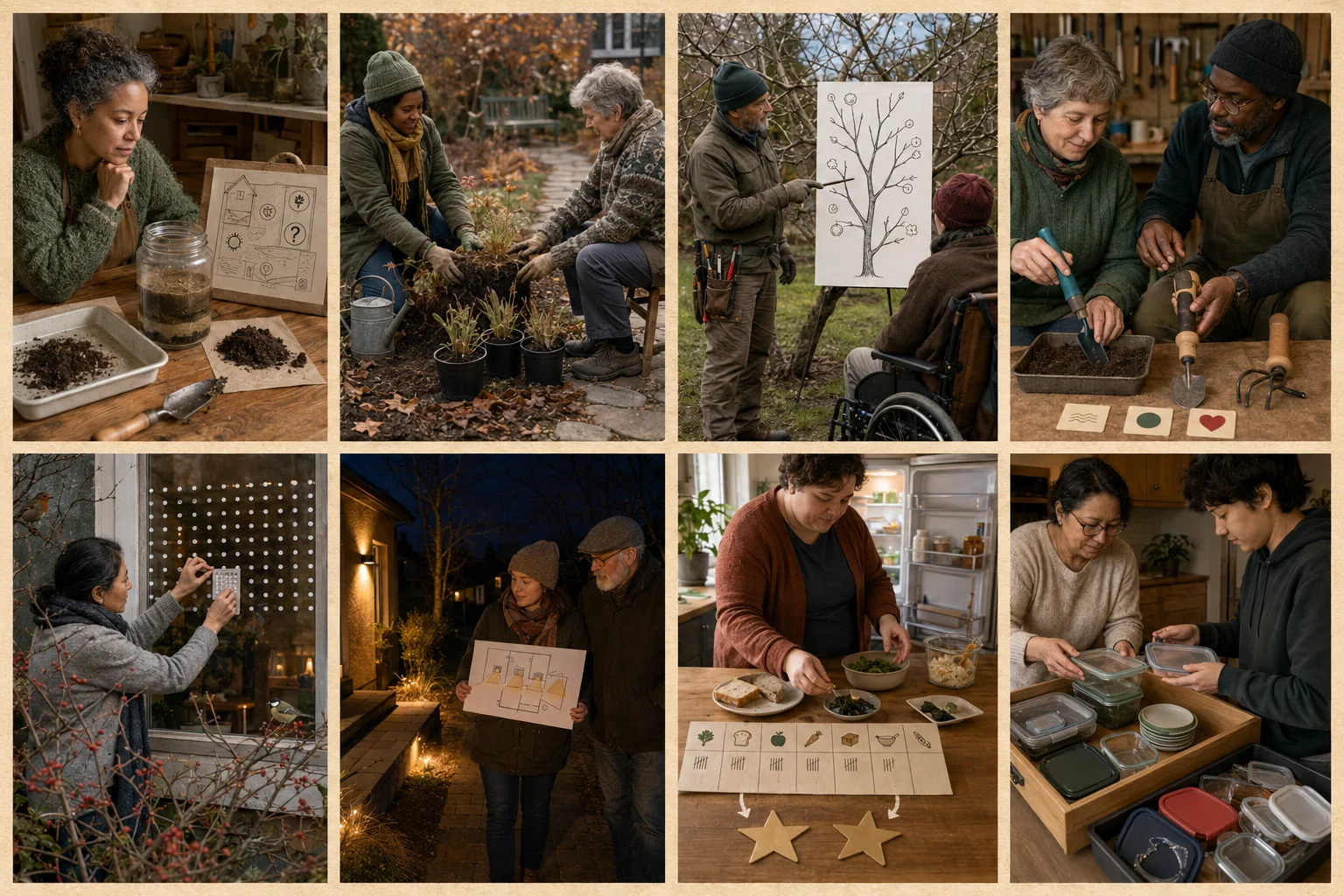
Collect a small permitted sample from one garden bed and run simple texture, drainage-observation, and soil-structure exercises from reliable local guidance. Record what can be observed, what remains unknown, and whether a qualified laboratory test is the sensible next step.
See fit and tradeoffs →Choose one correctly identified perennial that benefits from division, confirm the suitable local season, and help lift, separate, replant, water, and label only the amount the gardener wants. Offer healthy extras to named recipients who have appropriate sites and consent.
See fit and tradeoffs →Hire a qualified arboriculture or fruit-tree professional for a lesson centered on one existing tree, explaining structure, tool hygiene, season, and which cuts are appropriate or deferred. The recipient observes and marks a diagram rather than being asked to climb or copy advanced work.
See fit and tradeoffs →Measure one problem window and install a dense, exterior-visible collision-deterrent pattern supported by current bird-conservation guidance. Clean the glass, preserve egress and visibility needs, photograph the completed spacing, and leave replacement instructions.
See fit and tradeoffs →Walk the property at night with the household, mapping which exterior lights support an actual task and where light spills upward, sideways, or into neighboring habitat. Propose shielding, aiming, timing, or lower-output questions for a qualified installer without altering wiring.
See fit and tradeoffs →For seven ordinary days, record only discarded edible food, the reason it was not used, and the point where the decision changed. End by choosing two small prevention experiments, such as smaller purchase units or a visible use-first zone, without tracking individual blame.
See fit and tradeoffs →Match every food-storage lid to its container, test fit and condition, group a small working set by actual use, and responsibly route unmatched or damaged pieces according to local rules. Add at most the single missing size the household has clearly identified.
See fit and tradeoffs →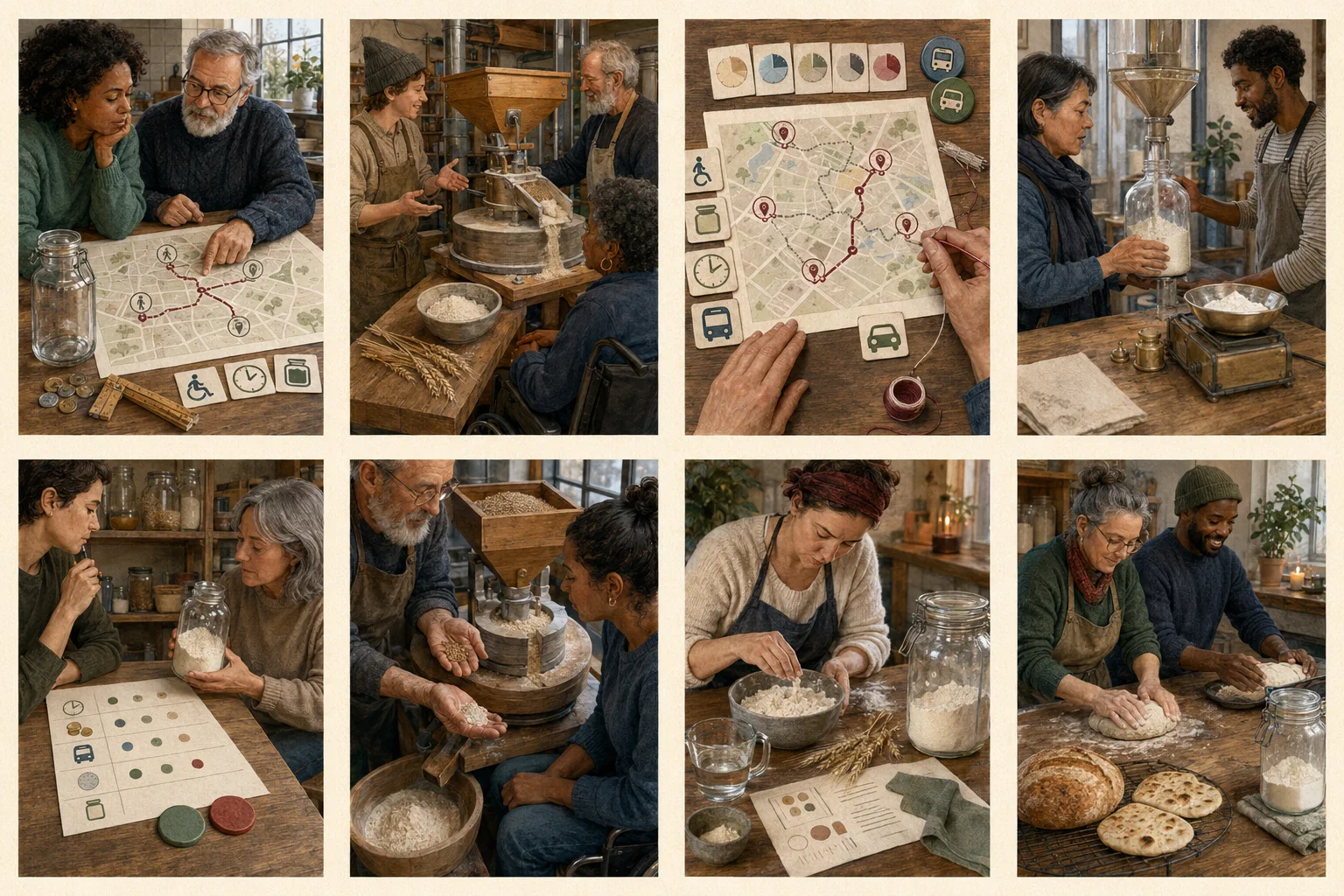
Map verified local refill options for only five household staples, recording container rules, unit pricing method, accessibility, hours, transit, and whether the stop fits an existing route. Trial one item for a month before expanding the system.
See fit and tradeoffs →Arrange an educational visit to a working local mill or grain educator that explicitly welcomes visitors, then buy one small, clearly labeled flour and bake a tested simple loaf or flatbread together. Record grain identity, milling date if supplied, storage, and recipe adjustments.
See fit and tradeoffs →
Take a short familiar walk to notice six ordinary sounds, represent each with a child-invented mark, and arrange the marks into a brief rhythm performed later with body percussion or quiet household objects. Record the final piece only if the child wants to keep it.
See fit and tradeoffs →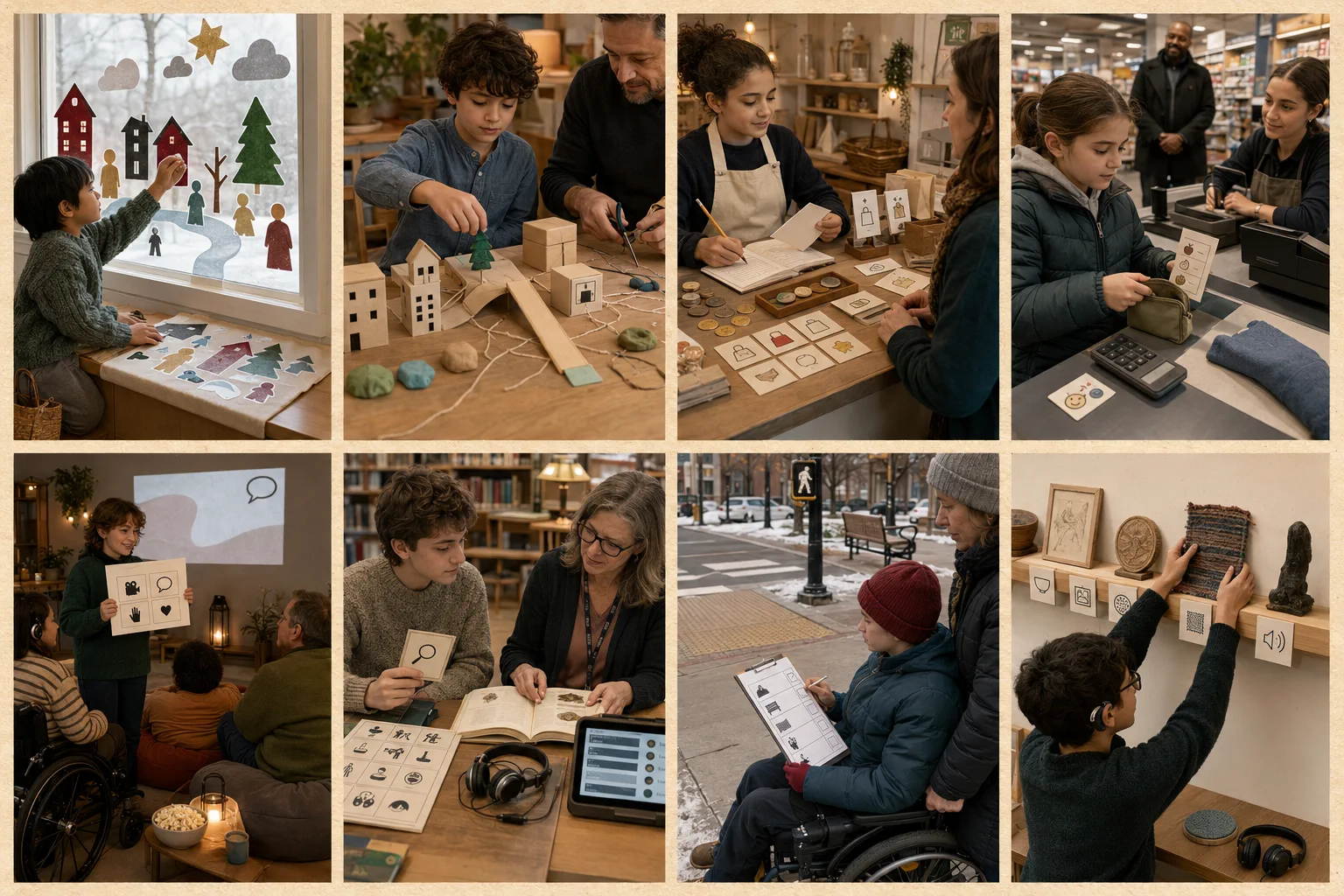
Help the tween design a one-afternoon simulated shop around paper products or objects they already make, calculate material cost, set sample prices, make change, handle a return, and close the books. Use play currency or invited family customers so there is no pressure to sell publicly.
See fit and tradeoffs →Choose one familiar low-pressure store and rehearse making a list, checking a clearly marked budget, asking for help, paying, reviewing a receipt, and handling an unavailable item. The adult stays nearby under a pre-agreed support plan while the tween completes the parts they are ready to own.
See fit and tradeoffs →Let the tween curate one lawful home screening from a short age-appropriate list, write a two-sentence introduction, choose a pause or discussion point, plan seating and captions, and close with one optional audience question. The adult handles access, food safety, and the end time.
See fit and tradeoffs →Arrange an age-appropriate appointment or quiet visit in which a public librarian helps the tween turn one self-chosen question into search terms, compare the catalog with a reference source, locate material in two formats, ask for help, record a citation, and identify what remains uncertain. The result may be a one-page answer, a new question, or no conclusion.
See fit and tradeoffs →Walk a short familiar route with a printed observation sheet to notice curb cuts, resting places, surfaces, sound, lighting, signs, crossings, and places to pause. The tween marks observations without rating individuals, then redesigns one feature on paper and identifies the appropriate public feedback channel if they want to learn more.
See fit and tradeoffs →
Choose one familiar age-appropriate journey and practice reading the route, recognizing the correct stop, checking direction, using fare, identifying a missed-stop plan, and contacting the trusted adult. Complete the real trip together with the tween leading and support available at the agreed distance.
See fit and tradeoffs →Enroll the tween in an age-appropriate first-aid course from a qualified local provider and attend if the program permits. Afterward, make one household practice card in the tween's own words covering how to get an adult, call emergency services, state the location, and follow dispatcher instructions.
See fit and tradeoffs →Book one private hour in a simple recording room or prepare a quiet home setup where the teen can record one original spoken-word piece. Include a short sound check, several complete takes, private playback, and one clean file, with no expectation that the recording be published or shared.
See fit and tradeoffs →Work with the teen to map three real destinations by walking, cycling where appropriate, public transit, and trusted rides. Add actual travel time, fares, lighting, weather backups, missed-connection steps, accessibility, and household check-in expectations, then fund and practice one route the teen chooses.
See fit and tradeoffs →Run two short practice interviews using questions matched to one real job, program, scholarship, or volunteer role the teen selects. Record only the second round with permission, then let the teen review it privately and choose one strength and one response to revise before deleting or keeping the file.
See fit and tradeoffs →Set aside two hours to help the teen compare three local organizations connected to a cause they chose. Review mission, actual volunteer tasks, age rules, safeguarding, time, transport, accessibility, and how the organization describes impact, then help the teen send one question or decline every option.
See fit and tradeoffs →Help the teen convert one approved, low-risk club event into a one-page runbook covering purpose, participants, permissions, room, access, roles, materials, budget, arrival, transitions, communication, cleanup, cancellation, and one likely disruption. Conduct a tabletop walkthrough with willing club members, then revise the plan in their language.
See fit and tradeoffs →
Arrange one lesson with a qualified driving instructor focused on a route type the teen identifies, such as merging, night preparation, parking, or an unfamiliar intersection pattern. Confirm the instructor will explain the plan, adapt the lesson, and end with a factual practice summary rather than a pass-fail judgment.
See fit and tradeoffs →Help the teen choose one real but manageable assignment and test three evidence-informed approaches across a week, such as retrieval, spaced review, worked examples, or teaching the concept aloud. Record time, effort, comprehension, access needs, and stress, then keep only what the teen finds useful.
See fit and tradeoffs →Choose one public local meeting with a manageable agenda, read the official agenda together, explain roles and public-comment rules, attend for a defined portion, and debrief what was decided, deferred, or unclear. The teen may observe silently and leave whenever the agreed exit condition is met.
See fit and tradeoffs →Sit with the young adult to turn a sample or actual proposed lease into a question list organized by total move-in cost, term, utilities, guests, pets, repairs, notice, renewals, insurance, accessibility, and move-out. Mark every legal interpretation as a question for a qualified local source rather than answering it yourselves.
See fit and tradeoffs →Create a private, editable timeline for the specific move listing which utilities and services are included, which require activation or cancellation, verified provider contacts, meter access, appointment windows, equipment returns, final readings, deposits, and confirmation numbers. The young adult completes every account action themselves.
See fit and tradeoffs →Help the young adult rehearse one real, low-risk conversation such as clarifying a project scope, requesting a schedule change, resolving a shared-house expense, or asking about a fee. Define the goal, facts, alternatives, limits, opening, questions, possible responses, and an exit, then switch roles for two practice rounds.
See fit and tradeoffs →With mutual consent, arrange a one-hour meal or accessible remote conversation with a practitioner whose work matches one question the young adult has. The young adult chooses three questions, the giver handles the meal or connection cost, and both parties receive clear boundaries, timing, and a graceful way to decline future contact.
See fit and tradeoffs →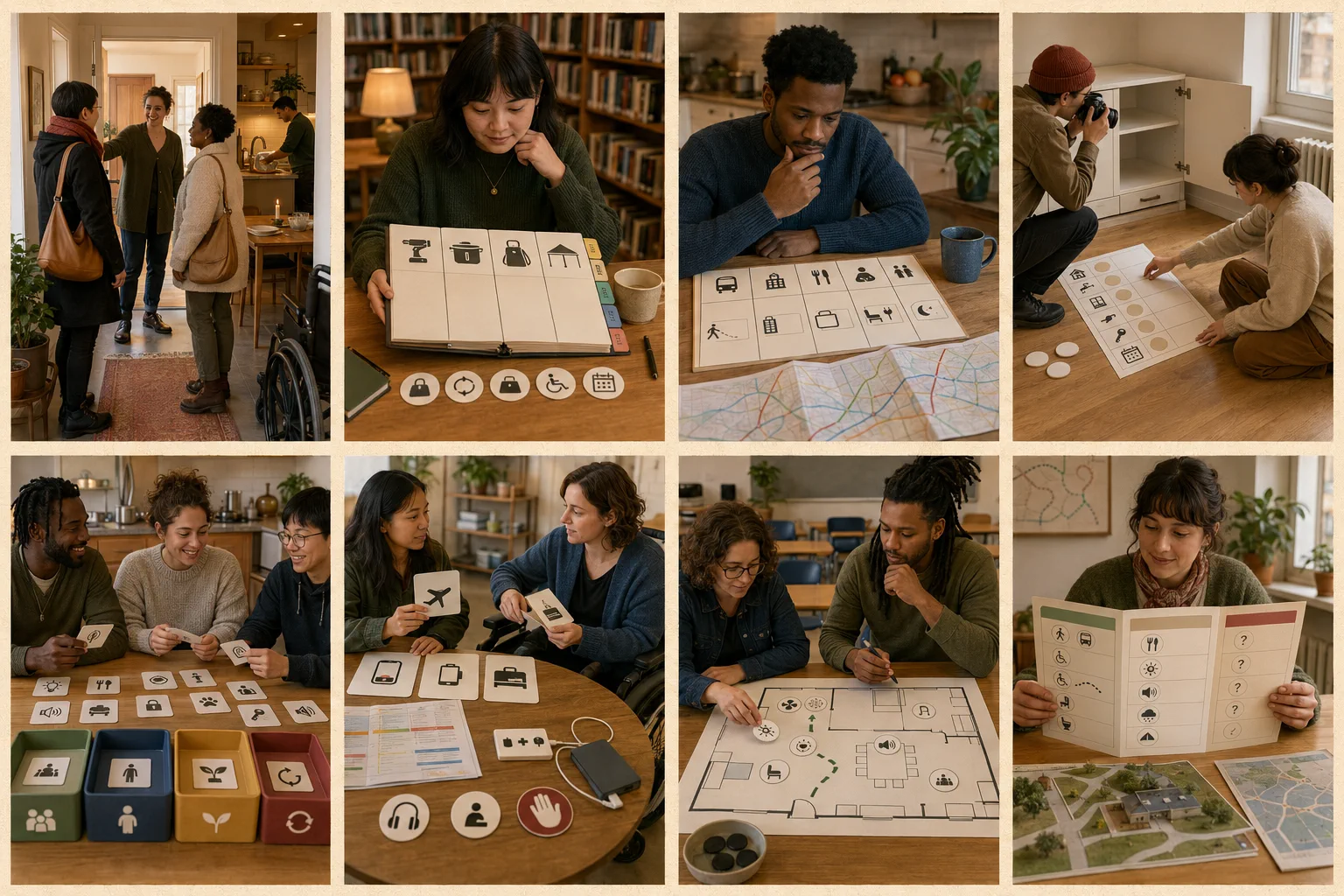
Help the young adult host one small meal by taking exactly one support role they choose, such as shopping transport, table setup, dishwashing, accessibility coordination, or departure cleanup. The host chooses guests, menu, style, budget, start and finish, and may use takeout or no cooked food at all.
See fit and tradeoffs →Research and build a private local directory of verified ways to borrow or rent common-use items, such as library equipment, tool libraries, outdoor gear, kitchen equipment, event supplies, and trusted household loans. Record membership rules, fees, deposits, access, pickup, return, damage, and current contact details without creating accounts.
See fit and tradeoffs →Help map the first five workdays around verified start times, commute and backup, building entry, lunch, clothing requirements, breaks, medication or access needs, childcare or care handoffs, charging, and a low-effort evening reset. Leave workplace duties and culture judgments to the employer and recipient.
See fit and tradeoffs →At the renter's direction, help create a dated room-by-room condition record using the property's official form plus clear photographs of observable surfaces, fixtures, appliances, included items, meter readings, and keys. The renter reviews, submits, stores, and follows up through the required process.
See fit and tradeoffs →Use one real upcoming trip to rehearse four disruptions: a delayed connection, dead phone, missing bag, and changed lodging or pickup. For each, identify official help, documents, payment limits, safe waiting places, trusted contacts, access needs, and the point at which the traveler stops improvising and asks for qualified assistance.
See fit and tradeoffs →With school and teacher approval, help map ordinary sound sources across one unoccupied classroom and one brief, nonrecorded instructional period. Note equipment hum, scraping, hallway transitions, voice direction, quiet zones, and student-described barriers, then help implement one reversible change the teacher and affected students choose.
See fit and tradeoffs →Take one bounded planning task off the educator by verifying the venue's arrival route, transportation, entry, distance, surfaces, seating, restrooms, food, sensory conditions, communication access, medical procedures, weather plan, and quiet or early-exit options. Return a dated question list that separates confirmed facts from unknowns.
See fit and tradeoffs →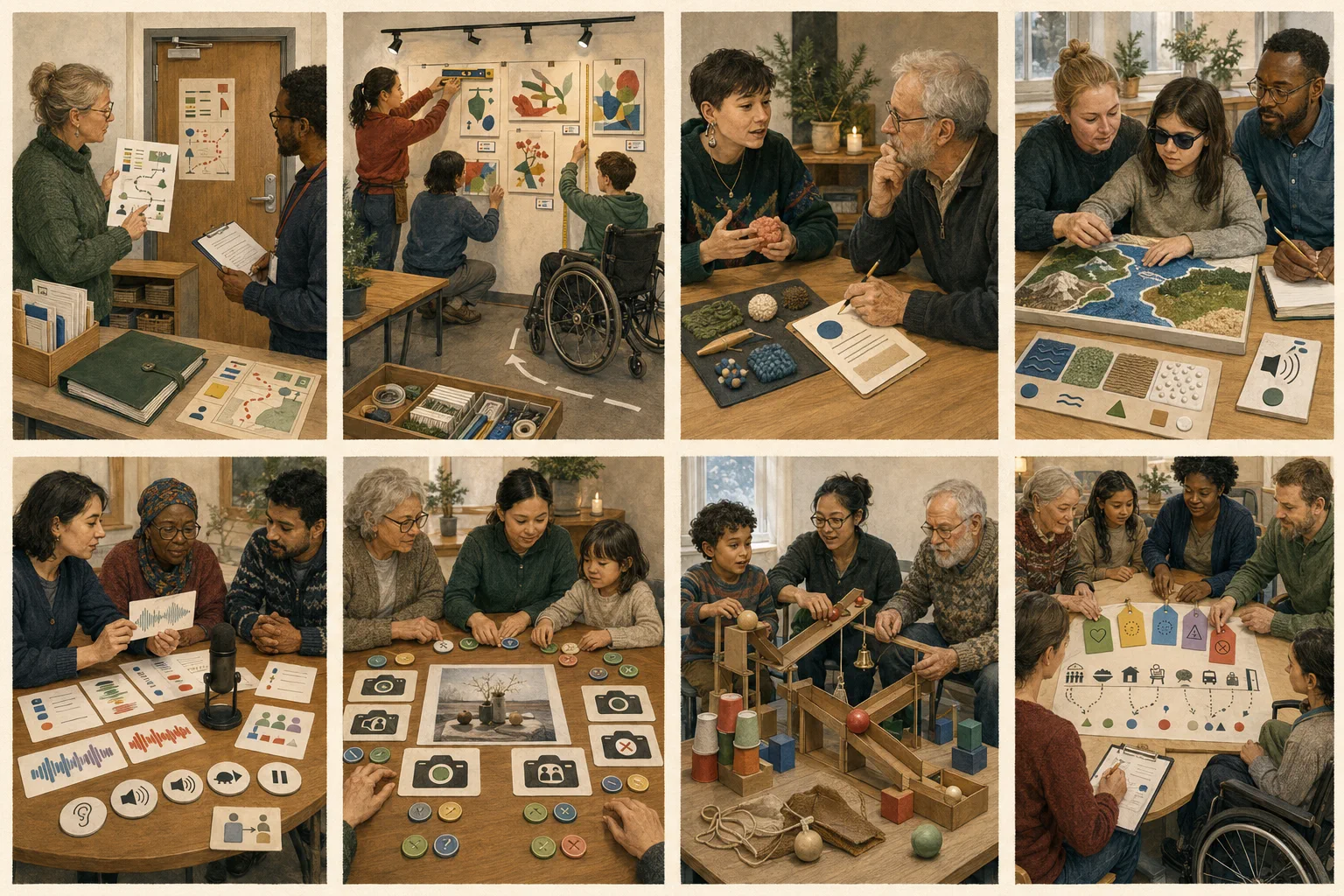
With school approval, act as a fresh reader while the educator walks through one ordinary substitute day using their existing plans. Flag only missing entry, schedule, materials, access, student-support, technology, dismissal, and emergency-process information, then help produce a one-page orientation that points to official documents rather than copying them.
See fit and tradeoffs →With school approval, provide a small crew for one defined installation shift covering measured layout, student-approved labels, safe removable mounting, lighting checks, accessible viewing heights, clear routes, and a documented takedown plan. The educator and students decide what is shown, credited, translated, or kept private.
See fit and tradeoffs →Invite the mentee to design a ninety-minute session showing the mentor one current tool, community, creative practice, access strategy, or way of learning that matters to them. The mentee chooses what remains off-limits, whether the lesson is hands-on, and what the mentor must prepare or unlearn before attending.
See fit and tradeoffs →Fund qualified translation and consenting native-speaker audio for one concise school-approved welcome message covering teacher name, how to reach the class, where to find translated information, and how families can request an interpreter. Provide clearly labeled audio and text versions without collecting family language data in the files.
See fit and tradeoffs →Facilitate a brief family process that separates permission to take a photograph, keep it, send it privately, post it, include children, add names, and retain it over time. Each willing person chooses simple signals and defaults, then the family tests one private sharing method using a non-sensitive sample image and records how anyone can withdraw consent.
See fit and tradeoffs →Set one safe tabletop goal, such as ringing a bell, and give each generation responsibility for one section of a low-energy chain reaction built from cardboard, ramps, string, cups, blocks, and rolling objects. Test interfaces together, allow sections to be operated manually, and stop after one complete run or a shared decision to leave it unfinished.
See fit and tradeoffs →Facilitate one brief planning conversation in which each willing person marks activities they want, may want, can help with, need adapted, or will skip. Turn the responses into a simple arrival-to-departure map with rest, food, medication privacy, transport, quiet connection, childcare, meaningful roles, and multiple exit points.
See fit and tradeoffs →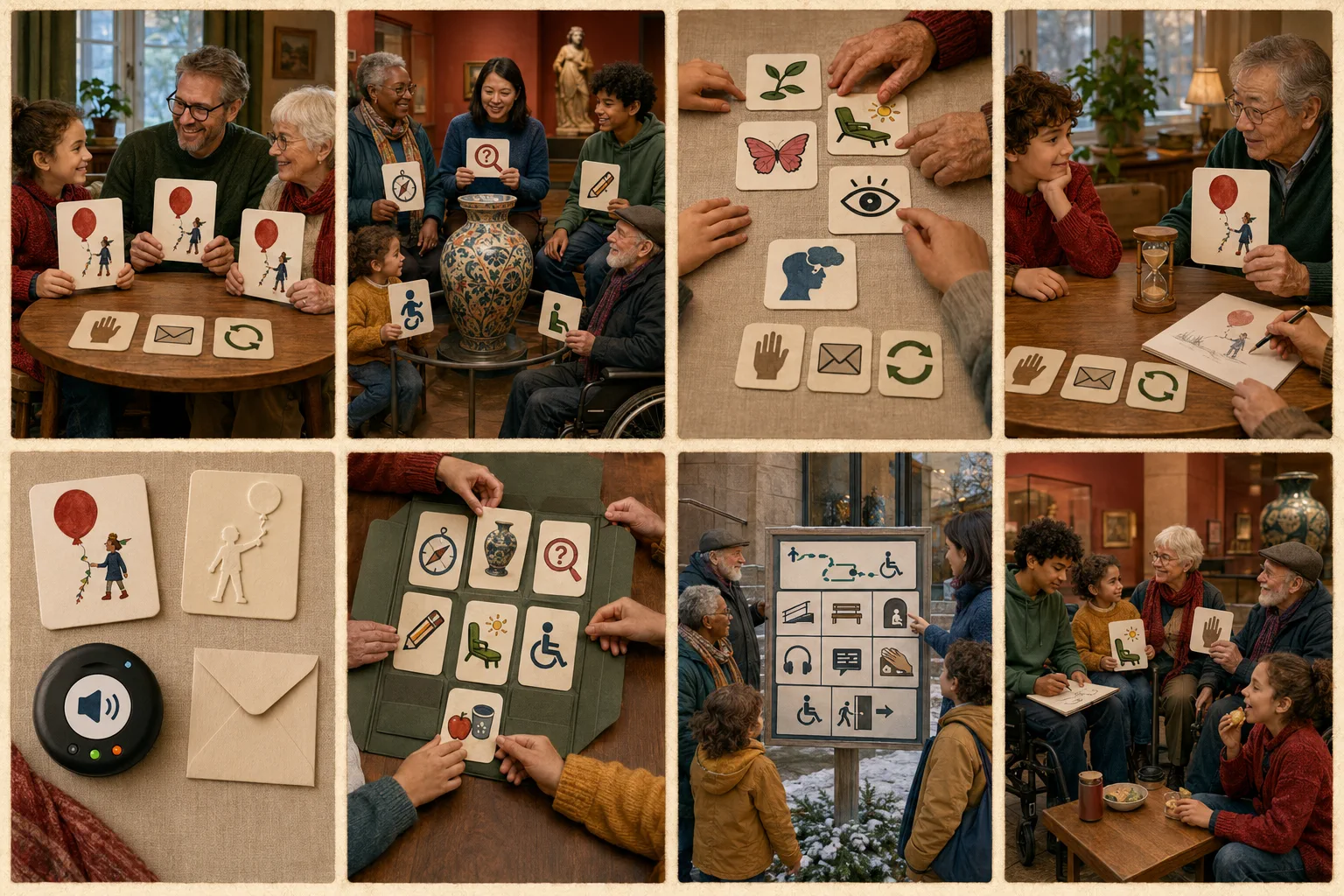
Plan one short museum visit around a single gallery or theme and give participants equal opt-in roles such as navigator, object chooser, question keeper, sketcher, rest caller, access checker, or snack planner. Confirm transport, admission, seating, quiet space, communication access, food, weather, and a clear early finish.
See fit and tradeoffs →
Each person chooses one small household skill they routinely perform, such as folding a fitted sheet, reviving a houseplant, setting up a video call, or sharpening a kitchen tool. Plan two twenty-minute teaching turns with the necessary materials ready, then write one concise reference card for each skill without redistributing chores or scoring competence.
See fit and tradeoffs →With explicit consent, hold one private conversation about what makes time together easier: notice length, transport, cost, mobility, seating, food, scent, sound, communication, support people, rest, cancellation, and preferred check-ins. Turn only the details both want remembered into a concise editable planning note, then use it to propose one genuinely suitable invitation.
See fit and tradeoffs →Invite the recipient to name one recent win and choose how, or whether, it should be marked. Offer three bounded forms such as a favorite meal with two guests, a quiet walk ending in a handwritten acknowledgment, or a private hour in a meaningful place. Handle the agreed reservations, access, transport, food, cleanup, and ending without adding surprises.
See fit and tradeoffs →Ask each person to submit two narrow curiosities, then choose one overlap and book a single legitimate public demonstration, short tour, lecture, or workshop. Verify the host, content, access, total cost, transport, and finish time; attend the first date together and end with a ten-minute debrief about whether any follow-up is actually wanted.
See fit and tradeoffs →With both friends' consent, produce a one-day reunion around one accessible home base and no more than two activities. Confirm travel, lodging if required, costs, food, quiet time, mobility, communication, caregiving constraints, photo preferences, and a firm finish. Pay or contribute only to the agreed items and provide a complete itinerary with flexible gaps.
See fit and tradeoffs →Offer a clearly bounded two-hour visit built around a recipient-chosen quiet activity: sitting near a window, walking a familiar level route, reading separately, or doing a simple hand task side by side. Bring the agreed drink or snack, handle transport if requested, and use a prearranged signal for conversation, pause, or ending.
See fit and tradeoffs →Plan a half-day in a mutually convenient public place with one current-interest activity, one easy meal, and no family administration. Agree beforehand on topics that are welcome, topics to leave alone, travel responsibilities, total spending, photo rules, and the finish time. Make the activity optional enough that conversation can remain ordinary.
See fit and tradeoffs →
Find a legitimate local art-lending program, library, artist rental, or permission-based family loan and let every resident review a small shortlist. Borrow one modest work only after unanimous approval, document its condition and terms, use renter-safe display hardware if permitted, and schedule the return before it enters the room.
See fit and tradeoffs →Ask the recipient which shelf, drawer, or lidded bin is easiest to reach and stock only their chosen nonmedical basics: shelf-stable drinks, familiar simple foods, tissues, unscented wipes, clean masks if used, thermometer batteries if compatible, a long charging cable, and a card with their own delivery and contact preferences. Date consumables and leave room for prescribed items they manage privately.
See fit and tradeoffs →Invite the departing roommate to choose four ordinary neighborhood stops that mattered during the shared-home period: the late grocery, bus shelter, laundromat, park bench, or takeaway counter. Walk or travel the accessible route together, buy one familiar snack, and let each person name one thing they will miss and one thing they are ready to leave behind, with no recording required.
See fit and tradeoffs →
Choose one large or awkward item, record its actual width, depth, height, weight if known, removable parts, and safe handling instructions, then measure every relevant doorway, corridor turn, stair, elevator, and destination clearance. Tape a full-size footprint in the new room and produce a factual path diagram with unresolved questions clearly marked for the mover or qualified carrier.
See fit and tradeoffs →With the resident present, spend one early evening identifying ordinary, observable sounds such as heating cycles, refrigerator motors, elevators, exterior traffic, pipes, doors, pets, and building announcements. Mark approximate source, timing, and which official contact handles genuine concerns, without recording neighbors or declaring any unexplained sound harmless.
See fit and tradeoffs →Choose one frequently used room and record resident comfort, sun, obvious drafts, humidity only if an existing reliable monitor is available, furniture placement, vent clearance, and window-covering use at three times in one day. Test only reversible changes such as moving a chair out of a draft, opening clear airflow, adding an existing throw, or adjusting approved coverings, then document what the resident actually prefers.
See fit and tradeoffs →Inventory only clean cardboard boxes, paper, reusable bins, bubble material, foam, and specialty packaging the resident wants to release. Verify current acceptance rules and hours for local reuse groups, moving-box exchanges, shipping stores, recycling sites, or material-specific drop-offs, then complete one agreed route and retain only a small labeled set the resident expects to use.
See fit and tradeoffs →Have a trusted person make one planned arrival while the resident tests the actual route: address visibility, legal parking or transit drop-off, call box, key or fob, door timing, lift, stairs, lighting, package area, accessible entrance, and how to reach the unit when one step fails. Record only official instructions and questions for building management.
See fit and tradeoffs →Conduct a structured ninety-minute interview across five real projects, paid or unpaid. For each, capture the situation, constraints, choices, collaborators, observable result, evidence source, and what the person would do differently. Sort the material into transferable themes without writing inflated claims, then return a private evidence bank the recipient can adapt for applications or conversations.
See fit and tradeoffs →
Pay a suitable editor, portfolio adviser, or privacy-aware practitioner to review one recipient-owned sample. Identify confidential, personal, licensed, employer-owned, client, security, and context-sensitive material; decide whether redaction, abstraction, recreation, a process narrative, or no sample is appropriate; then produce one clearly labeled draft with an audit list for the recipient to approve.
See fit and tradeoffs →Arrange a focused interview covering current work, relevant history, methods, audience, evidence, limits, and what the recipient wants next. Draft a one-line introduction, a sixty-word bio, and a 150-word bio in the recipient's voice, with placeholders where a claim needs verification. Include a plain-text version and let the recipient remove titles or identity details they do not want public.
See fit and tradeoffs →Use an established public program, professional association, training provider, or willing practitioner with workplace approval to arrange a bounded observation. Agree on confidentiality, safety, dress, access, what may be observed, questions, compensation or meal, and finish time. Prepare the recipient to distinguish routine work, exceptional events, and questions still unanswered.
See fit and tradeoffs →Help the recipient list the benefits and transition points they need to verify: eligibility dates, premiums, deductibles, paid leave, retirement vesting, disability coverage, life insurance, flexible accounts, dependent coverage, tuition, remote-work costs, equipment, notice, continuation options, and official contacts. Mark every item as confirmed, unanswered, or for qualified advice, and store source dates.
See fit and tradeoffs →After the recipient verifies actual dress and safety requirements, help assemble five comfortable work combinations from their current wardrobe. Photograph or sketch only with permission, identify fit, movement, laundering, temperature, pocket, footwear, sensory, religious, gender-expression, and mobility needs, then fund one priority alteration or missing versatile piece chosen by the recipient.
See fit and tradeoffs →Help the recipient design one experimental week with intentionally different kinds of time: one obligation-free morning, one social window, one movement or outdoor option, one learning block, one practical block, one quiet day, and generous unscheduled space. Handle the logistics for one chosen activity, then review energy and enjoyment without turning the week into a productivity plan.
See fit and tradeoffs →Offer a choice among six verified weekday possibilities, then schedule three across two months: for example a quiet museum hour, public garden walk, matinee rehearsal, maker demonstration, courthouse architecture tour, or library program. Confirm current access, transport, total cost, seating, food, and finish; each outing stands alone and can be skipped.
See fit and tradeoffs →
Co-design a one-page template that separates participant questions, clinician or service-provider statements, instructions received, tests or documents mentioned, dates, responsible person, unresolved questions, and the official portal or contact. Trial it during one nonurgent appointment only with the care recipient's permission, then revise the layout for the person who owns the information.
See fit and tradeoffs →With the care recipient leading wherever possible, define what a substitute supporter needs in the first ten minutes: how to greet and communicate, immediate preferences, what is happening today, where official instructions live, what the helper may and may not do, who to contact, and when to stop and seek qualified help. Rehearse once with a willing trusted person and revise only the gaps that appeared.
See fit and tradeoffs →Help the person create an editable card covering how to ask, best time and length, number of visitors, masks or scent if relevant, food and touch preferences, conversation or quiet, help that is welcome, help that is not, communication method, photos, and how a visit may end early. The person chooses who receives it and may change or withdraw it anytime.
See fit and tradeoffs →Write one specific invitation that offers five equal replies: attend normally, arrive for a short named portion, join remotely, accept a quiet alternative on another day, or decline with no explanation. Include exact timing, transport, food, quiet space, the person who can help them leave, photo expectations, and whether the person who died or the loss will be mentioned.
See fit and tradeoffs →Agree on one event, earliest and latest pickup windows, exact entrance, mobility or communication needs, who may request the ride, a short coded message, backup transport, and whether conversation, music, food, or silence is preferred. The giver remains sober and available only if they can reliably do so, or prepays a legitimate flexible ride selected by the recipient.
See fit and tradeoffs →Let the recipient choose one familiar concert, lecture, service, game, film, or community event they already understand. Secure a transferable or flexible seat where genuinely available, choose aisle or quiet-area placement, plan transport and an early exit, and identify a nearby non-event option so the evening still works if entering feels wrong.
See fit and tradeoffs →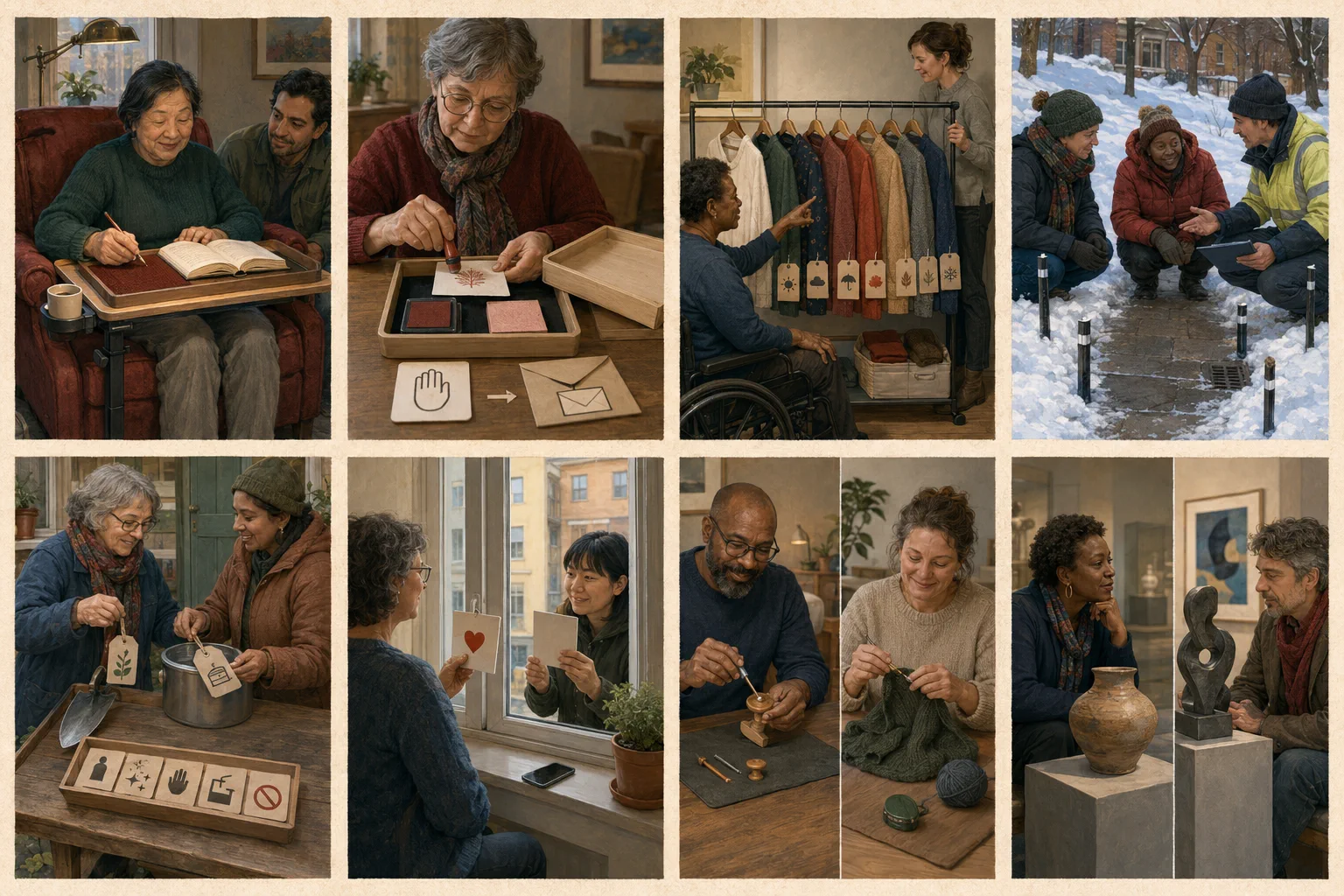
With the recipient directing every choice, select seven comfortable combinations from clothing they already own for the actual week ahead. Check weather, laundry, appointments, rest days, sensory and access needs, then place complete outfits on one existing rail or in seven labeled shelf sections. Handle the agreed washing, simple steaming, and return of rejected pieces without discarding anything.
See fit and tradeoffs →Each person chooses one low-risk object from the same broad category, such as a loose wooden drawer pull, a sweater snag, a paper book jacket, or a simple bicycle accessory removed from the bicycle. Verify repair methods separately, obtain the small correct materials locally, then meet by video for a one-hour side-by-side repair with stopping points and no expectation that both tasks finish.
See fit and tradeoffs →Each person chooses one current local museum or gallery and one object they want the other to encounter through an official online record, their own notes, or a live call where venue rules allow. Verify admission, photography, connectivity, source details, and access. Meet afterward for a forty-minute conversation using the same prompts about material, scale, context, uncertainty, and personal response.
See fit and tradeoffs →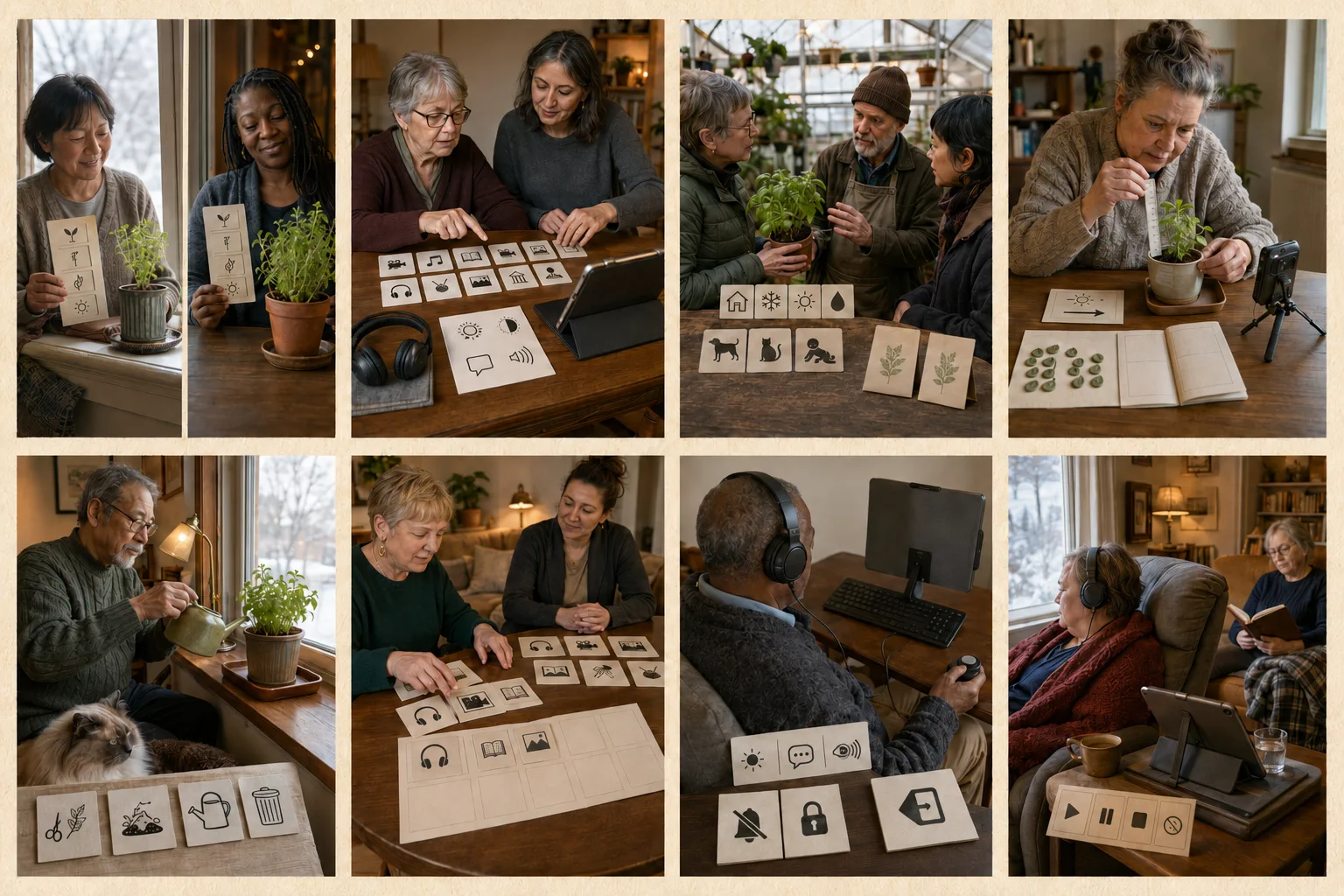
With the recipient directing every choice, build one simple offline-capable screen or device folder containing no more than twelve familiar items they already lawfully access: short audio, captioned video, large-print text, photographs, guided handwork instructions, or direct links to owned or public-library material. Use large descriptive buttons, remove autoplay and notifications where possible, test volume and brightness, and include a visible exit to the ordinary device home screen.
See fit and tradeoffs →
Book a short print-studio session to design and press one sturdy outer envelope and two matching sheets for a letter the recipient may write now or later. Keep the design abstract, leave the contents private, and include a second plain envelope if the letter should eventually travel.
See fit and tradeoffs →Select no more than ten owner-approved paper items and host a ninety-minute identification session. Record what is known, what is remembered differently, and what remains uncertain on separate decoder sheets, using source names and confidence labels rather than merging guesses into a single family story.
See fit and tradeoffs →With the owner's participation, sort one drawer into dated, approximately dated, undated, private, and release categories. Build a simple removable chronology with citations back to folder numbers, then return every unresolved item to an explicit 'owner decides' folder rather than forcing completion.
See fit and tradeoffs →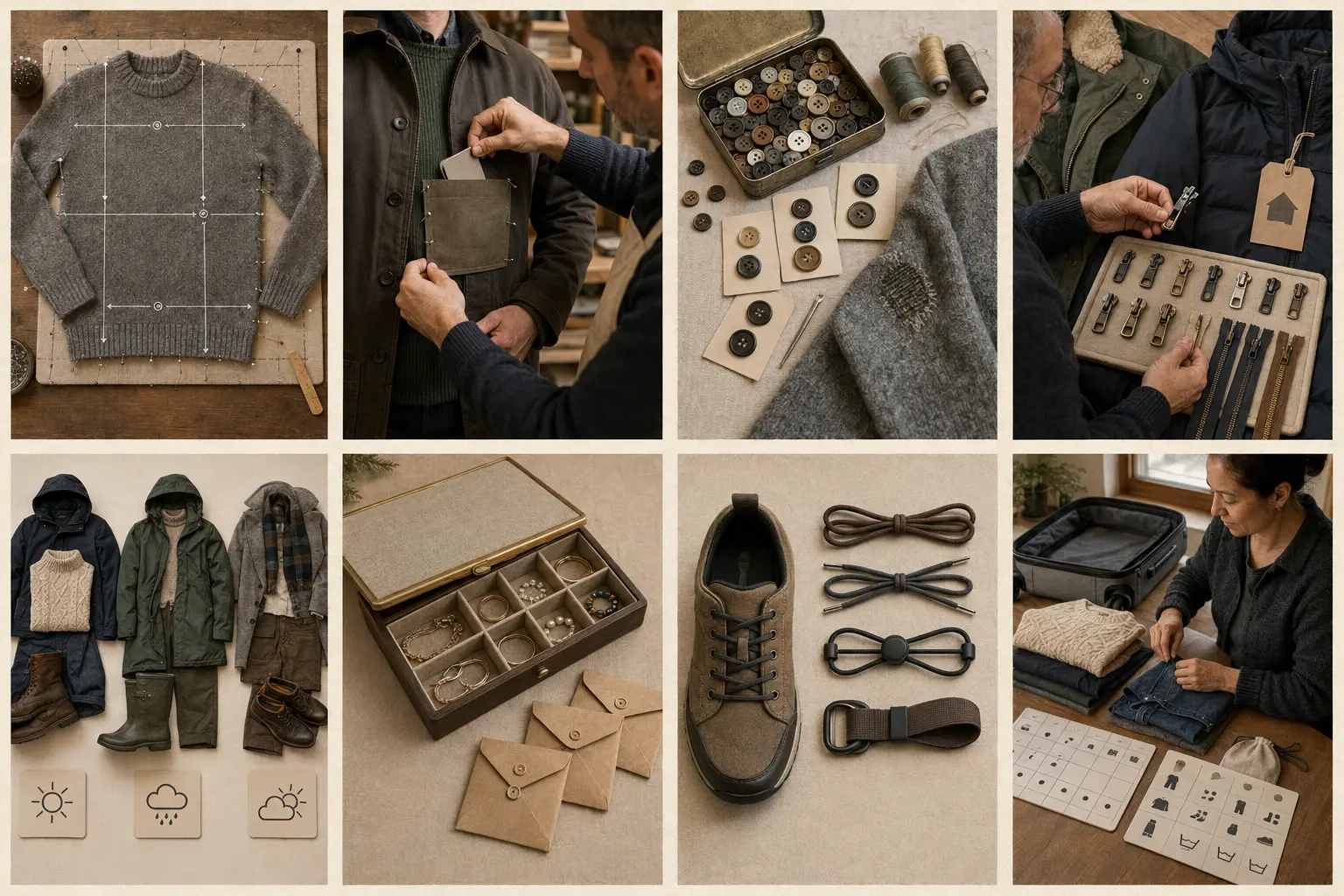
Arrange a fiber-aware assessment and supervised wash-and-block session for one recipient-chosen knit. Record measurements before and after, identify the fiber only as confidently as labels or expertise allow, and stop if damage, dye instability, or construction makes wet treatment unsuitable.
See fit and tradeoffs →Bring one recipient-approved garment and the actual object it needs to carry to a tailor. Test pocket position, reach, weight, closure, drape, washability, and seated comfort with a temporary mock-up before choosing an internal, patch, or seam design.
See fit and tradeoffs →Arrange assessment, drop-off, and pickup for one recipient-approved zipper item, while providing a temporary substitute that meets the same weather, carrying, or access need. Ask the repairer to distinguish slider adjustment, pull replacement, partial repair, and full zipper replacement before work begins.
See fit and tradeoffs →Using the recipient's own forecast source and chosen clothes, test three complete combinations for cold-dry, cold-wet, and indoor-outdoor days. Photograph only approved outfits, note where heat, moisture, reach, or storage becomes uncomfortable, and identify at most one genuine gap after the rehearsal.
See fit and tradeoffs →Build a trip-specific calendar from the recipient's confirmed activities and laundry access, then wear-test a small set of existing clothes through one ordinary day. Photograph approved combinations, weigh the packed set if useful, and identify only functional gaps that the rehearsal actually reveals.
See fit and tradeoffs →
Take one recipient-approved chair out of use and arrange a furniture repair assessment that identifies the loose joints, prior repairs, finish concerns, and safe treatment options. Request a written estimate before any disassembly and provide a temporary seat while the chair is away.
See fit and tradeoffs →Have a knowledgeable maker inspect one wooden board for splits, warping, construction, contamination concerns, and remaining thickness. If appropriate, demonstrate controlled resurfacing on a practice offcut before flattening, smoothing, cleaning, drying, and finishing the board with materials intended for that use.
See fit and tradeoffs →Bring one recipient-approved umbrella to a repair clinic or experienced maker to assess ribs, runner, tips, handle, canopy, and safe opening. Replace or stitch only suitable components, then perform a controlled spray test outdoors and a full dry-down rehearsal before returning it to service.
See fit and tradeoffs →Arrange assessment of the suitcase shell, wheel assemblies, bearings, fasteners, handle, and available replacement parts. If repair is responsible, handle drop-off and pickup, then load-test the empty and normally packed case over the recipient's real doorway, pavement, and transit transitions.
See fit and tradeoffs →Arrange an in-place or carefully transported diagnostic by a qualified clock professional. Ask for condition photographs, a plain-language explanation of movement, case, dial, prior repair, missing parts, and options ranging from safe stabilization to full service before authorizing work.
See fit and tradeoffs →Bring photographs and, only when safe, the recipient-approved artwork to a qualified framer. Compare window proportion, support, glazing, backing, light exposure, wall color, and future reversibility with sample corners before choosing whether to reuse the existing frame.
See fit and tradeoffs →Ask a basket maker to assess the base, rim, weave, prior repairs, handle attachment, and intended load. Choose compatible material and a clearly explained repair approach, then test the finished basket first with light household contents before returning it to ordinary use.
See fit and tradeoffs →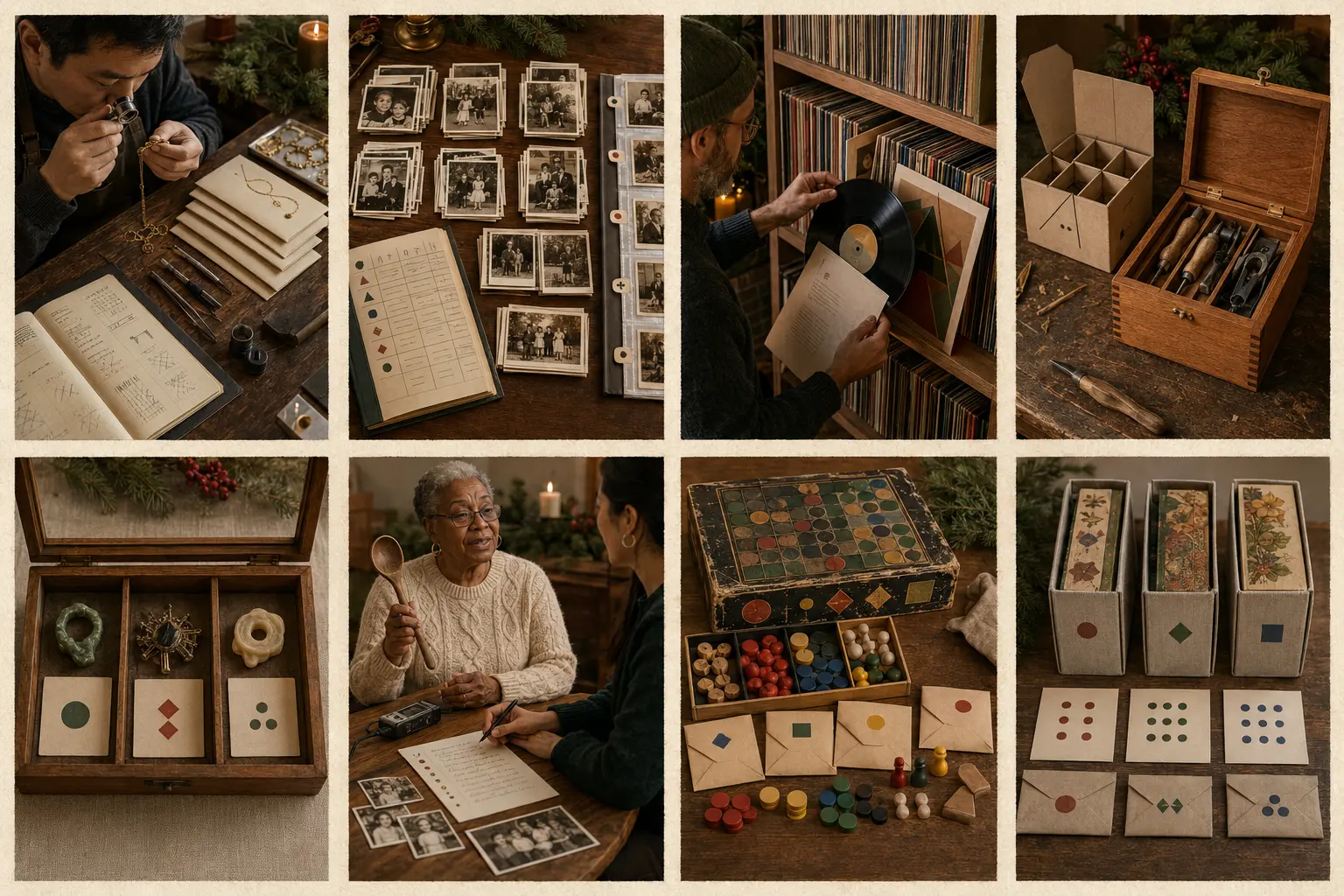
Arrange a jeweler's condition inspection for up to five owner-selected pieces, focusing on clasps, links, settings, wear points, and cleaning limits. Create a private ledger with photographs only where permitted, family history clearly separated from professional observations, and no assumed valuation.
See fit and tradeoffs →Let the owner choose one ordinary object, then record a short interview about where it came from, how it was used, what changed, what is uncertain, and what should happen to it later. Pair the consented recording with four plain photographs and a transcript the speaker can edit or delete.
See fit and tradeoffs →Create a lending agreement for three puzzles already owned by willing participants. Photograph the box fronts, record piece counts after a completed check, add one missing-piece envelope per set, and schedule the first exchange with clear return, cleaning, pet, smoke, and spoiler preferences.
See fit and tradeoffs →
Arrange a model-specific orientation using the recipient's own machine and manual. Cover safe setup, threading, bobbin, straight stitch, reverse, tension observation, needle changes, jam response, shutdown, and one scrap-fabric practice seam, stopping before repairs or advanced adjustments.
See fit and tradeoffs →Arrange a qualified seat weaver's assessment and, if appropriate, an owner-observation window during preparation or a small practice frame demonstration. Document material, pattern, frame condition, expected appearance, and future use limits before authorizing repair.
See fit and tradeoffs →Book a supervised studio demonstration using instructor-provided scrap to show scoring, breaking, edge finishing, fit, cleanup, and safe disposal. Let the recipient complete a small nonfunctional sample grid only if the studio's equipment, ventilation, protective practices, and instruction support it.
See fit and tradeoffs →Arrange a supervised enamel studio taster centered on a small numbered test strip. The instructor explains substrate preparation, color change through firing, kiln boundaries, ventilation, cleanup, and material limits; the recipient chooses a few colors and records expectations beside the fired results.
See fit and tradeoffs →Bring one recipient-chosen nonpowered hand tool to an appropriate craftsperson for inspection of the working end, tang or attachment, handle condition, balance, grip, and intended task. Mock up handle shape and size before repair or replacement, then test only in a controlled task.
See fit and tradeoffs →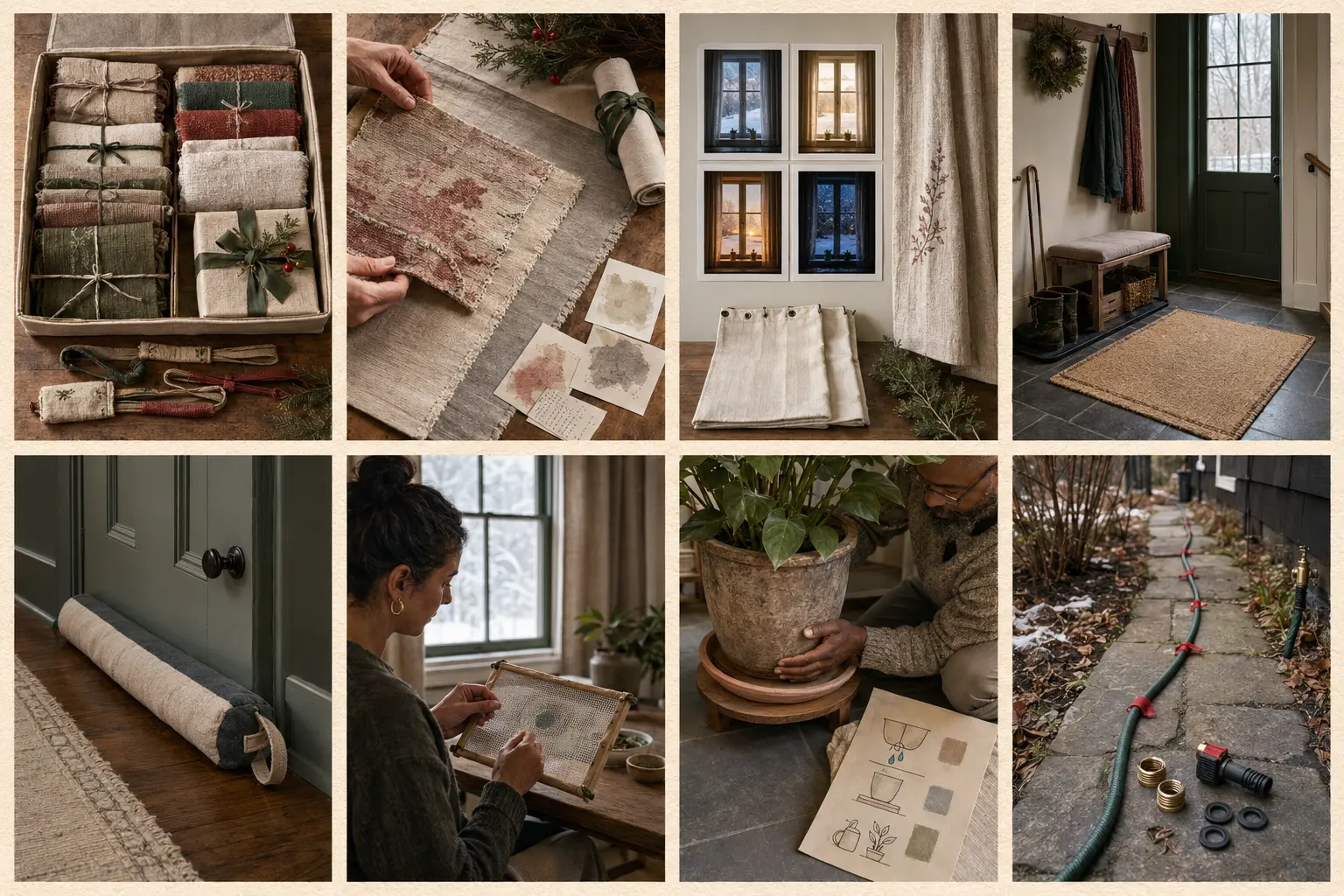
Gather only the household's existing wrapping cloth, ties, tags, and bags; wash where material guidance permits, mend edges, remove unsafe fasteners, sort by actual parcel size, and create a flat measurement folio with one example fold for each shape the household uses.
See fit and tradeoffs →Observe one window at agreed morning, afternoon, evening, and nighttime moments for a week, recording glare, privacy, heat perception, views, and current curtain behavior. Then ask a tailor or installer to propose the smallest reversible change such as hemming, lining, overlap, tie position, or separate removable panel.
See fit and tradeoffs →Inventory the host's existing mats, washable runners, towels, boot trays, and coat supports; launder or clean only according to material guidance with recipient-approved fragrance-free methods; then rehearse arrival for the actual guest count and identify one missing function at most.
See fit and tradeoffs →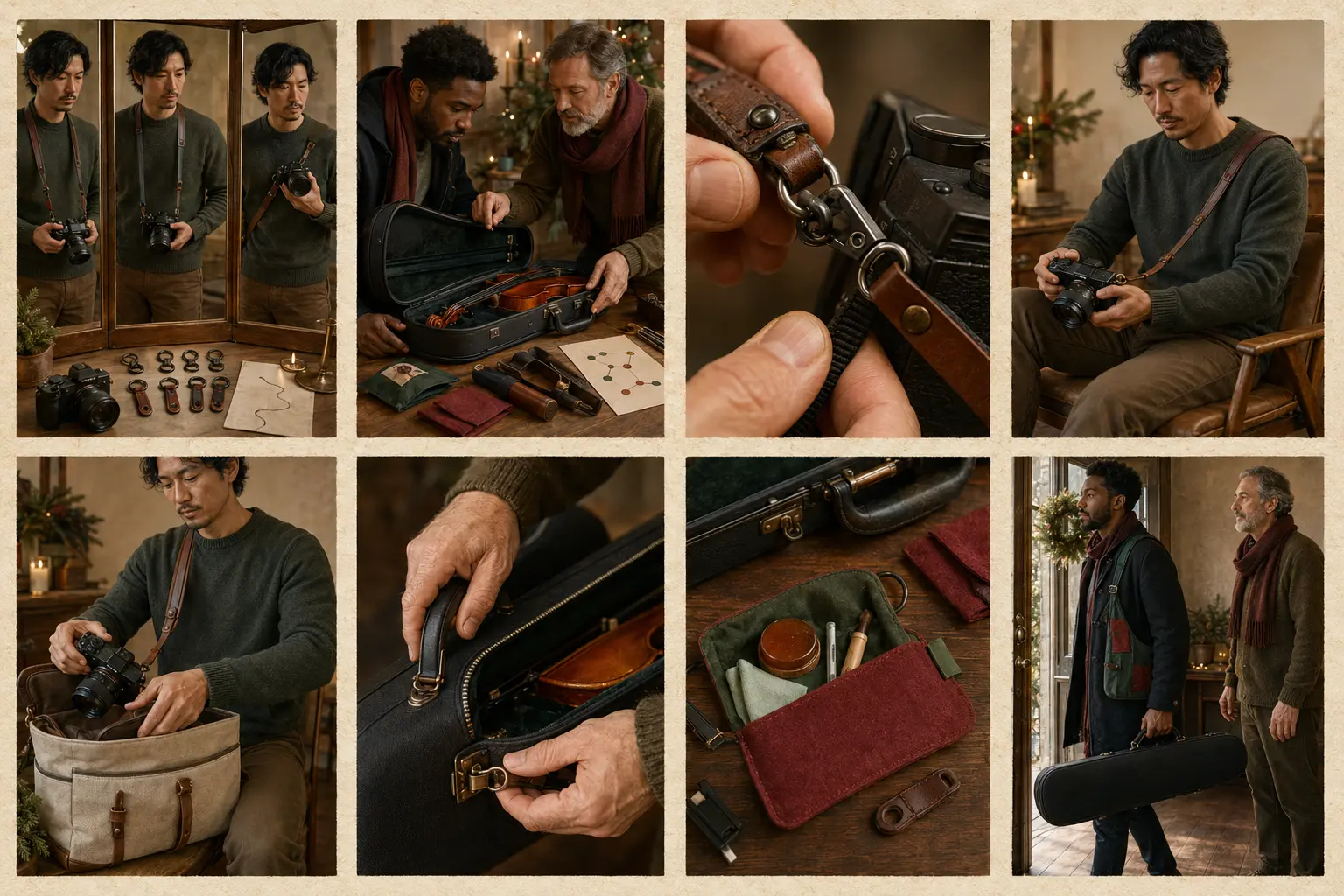
Use the recipient's actual camera and usual lens to compare existing strap positions, length, anchor condition, grip, clothing interaction, seated carry, bag transfer, and a short familiar walking route. Trial borrowed or returnable alternatives only after identifying the exact discomfort or access problem.
See fit and tradeoffs →With the musician and an appropriate instrument professional, inspect case condition, instrument support, closures, accessory movement, bow or mouthpiece storage, music transport, identification, and the complete door-to-rehearsal carry sequence. Add only reversible dividers, pouches, or labels that do not contact or compress the instrument improperly.
See fit and tradeoffs →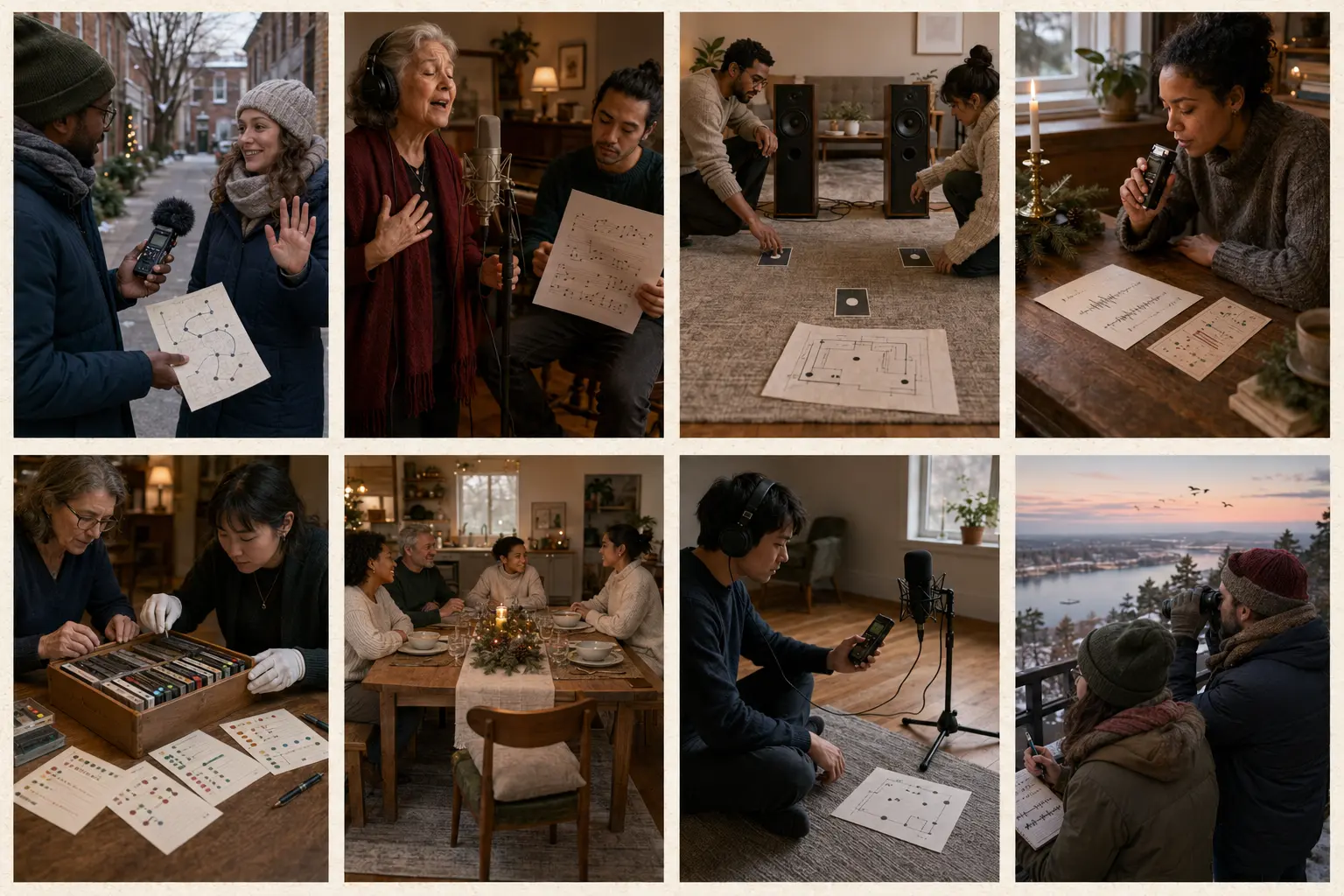
Walk one short recipient-chosen route at two agreed times, recording only ambient sound where rules and consent allow. Mark each clip on a hand-drawn map with time, weather, what is known, and what remains unidentified, then edit a private five-minute sequence together.
See fit and tradeoffs →Using only the recipient's current speakers and furniture, mark the original positions, test three reversible placements at ordinary volume, and sit in each usual seat. Record differences in speech clarity, balance, cable safety, neighbor impact, and daily room use before restoring or choosing one layout.
See fit and tradeoffs →With the owner present, number one small box of cassettes, transcribe labels exactly, note shell damage or uncertainty without playing questionable tapes, and prioritize five recordings for a qualified transfer assessment. Keep originals in order and separate personal recordings from commercial releases.
See fit and tradeoffs →Before one gathering, seat willing household members in the real room and test table position, background music off, soft furnishings already owned, lighting, turn-taking cues, and a quieter adjacent place. Write a simple host plan based on what improves conversation without buying unverified hearing devices.
See fit and tradeoffs →Choose four locations the recipient already has permission to use and record sixty seconds of steady room tone in each, noting time, appliance state, microphone position, and interruptions. Import the clips into one practice project and demonstrate how consistent labels support editing without claiming noise can always be removed.
See fit and tradeoffs →Choose one safe accessible listening point and visit for twenty minutes on three mornings, recording time, light, weather, direction, rhythm, and only species identifications the recipient can support. Compare the three sound patterns without playback calls, baiting, approaching nests, or ranking the mornings.
See fit and tradeoffs →
Watch no more than one hour of already playable family footage with willing relatives, stopping to log visible dates, places, people, uncertainty, and privacy flags by timecode. Create an editable chronology without re-editing, colorizing, posting, or resolving disagreements by guesswork.
See fit and tradeoffs →Choose one thirty-second scene and test three looks using only safely placed household lamps, daylight control, white card, and camera settings the recipient already has. Photograph each layout, note exposure and color compromises, restore the room, and edit the scene only after choosing one intentional look.
See fit and tradeoffs →Choose one lawfully accessible film with verified captions, test their accuracy and readability on the actual screen, and plan two optional pause points for reading or rest. Send a short content and timing note beforehand, keep discussion optional, and close at the promised time.
See fit and tradeoffs →Choose a short verified public-domain silent film, divide it into four cue sections, and invite willing guests to create simple live sound using voices, household percussion, or an instrument they already play. Rehearse volume and cues once, provide captions or plot context, and serve an easy meal after the performance rather than during it.
See fit and tradeoffs →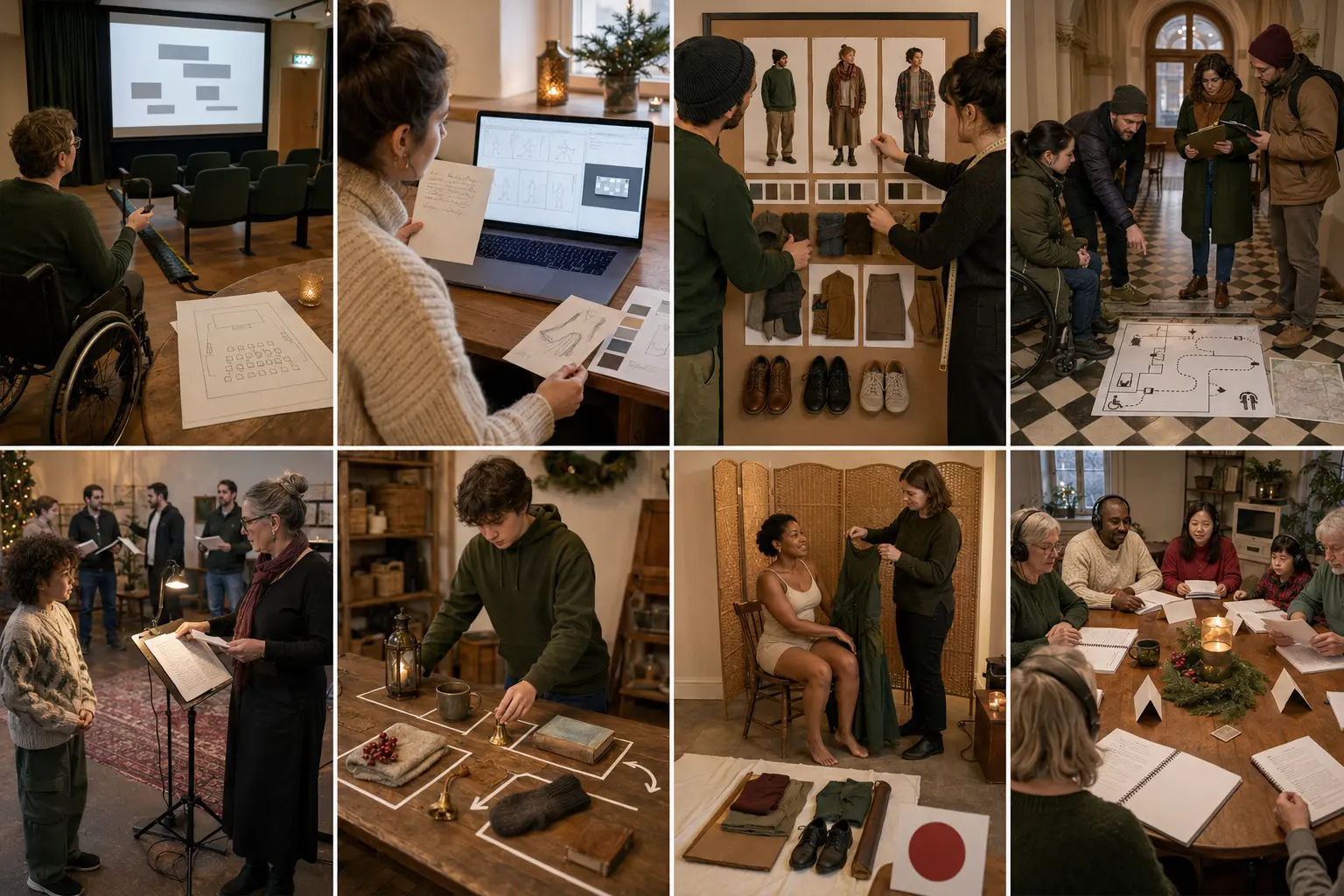
Before invitations go out, use a borrowed or existing projector to test the actual wall or screen at the intended hour. Mark image size, caption readability, glare, fan noise, seat views, cable protection, ventilation, exits, and a nonprojection backup, then restore the room and document only the workable layout.
See fit and tradeoffs →For one fictional character, photograph only recipient-approved garments already owned, then build three complete combinations tied to scene, weather, movement, continuity, and character change. Wear-test each look seated and moving, record laundering and duplicate limits, and return every item to its owner.
See fit and tradeoffs →Visit one permitted potential location with the intended participant or their access requirements in hand. Record arrival route, transport, thresholds, surfaces, toilets, seating, sound, light, power boundaries, weather exposure, quiet space, emergency exit, and a comparable fallback before judging its appearance.
See fit and tradeoffs →Arrange a permitted observation window with a working stage manager during a rehearsal or demonstration, focused on one short cue sequence from preset through reset. Provide the recipient with a blank sample cue sheet, glossary, questions in advance, and a debrief that separates venue practice from universal rules.
See fit and tradeoffs →With the performer, costumer, and dresser if used, rehearse one change at reduced speed in the actual or accurately mapped space. Test garment order, closures, reach, balance, privacy, communication, chair or support placement, lighting, emergency stop, and a slower artistic alternative before setting any target time.
See fit and tradeoffs →Choose a short verified public-domain script, edit only a working copy for large print and role clarity, and hold a ninety-minute table read with voluntary speaking, sound-cue, timekeeper, and listener roles. Share content notes and pronunciation questions beforehand, then close without requiring a recording or performance.
See fit and tradeoffs →
Book a qualified coach or scene partner for one excerpt and begin by agreeing on content, touch, distance, volume, repetition, recording, and stop language. Work beats at reduced intensity, identify one playable objective and one communication adjustment, then finish with a decompression and next-step note.
See fit and tradeoffs →Walk the actual audience journey with venue permission: arrival, ticketing, queue, seating, toilet, quiet space, caption or interpretation point, interval, reentry, emergency information, and departure. Invite feedback from people with relevant lived experience, record gaps without promising instant fixes, and publish only verified practical information.
See fit and tradeoffs →With the owner, identify only the nonsecret expiry or review dates they choose for travel documents, permits, memberships, policies, certifications, or identity records. Build a twelve-month reminder map that stores dates and responsible person, not document numbers or images, and includes official verification as a separate step.
See fit and tradeoffs →Help the owner assemble the model information, purchase record they already possess, symptom timeline, photographs, prior contact, warranty terms, and desired remedy for one product. Draft but do not send a concise claim, rehearse the contact route, and let the owner approve every fact and submission.
See fit and tradeoffs →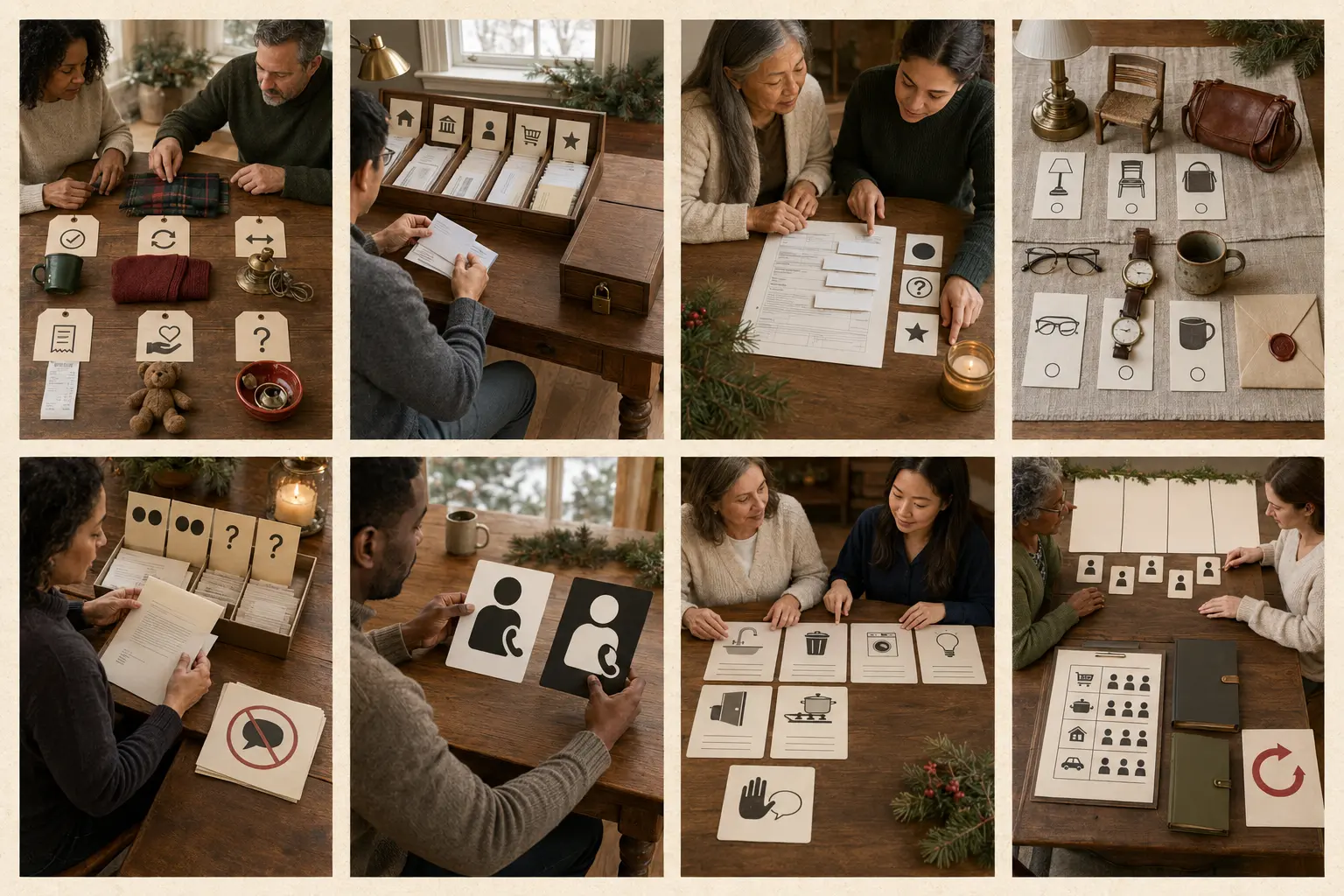
Set one afternoon to sort only recipient-approved items into keep, return, exchange, gift receipt needed, donate later, and unresolved. Confirm actual policies and deadlines from source materials, pair each action with its owner and transport method, and complete only the errands the owner authorizes.
See fit and tradeoffs →Choose one nonurgent form the owner wants help with, read the official instructions together, mark what is known, unknown, optional, and needs qualified advice, and let the owner enter every sensitive answer. Prepare attachments, accessibility requests, and a copy plan without submitting until they approve.
See fit and tradeoffs →With the donor, gather one year's acknowledgment letters and receipts they already have, sort them by date and organization, flag missing or unclear records for the donor to follow up, and create a clean index for their chosen records system. Stop before valuation, deductibility, or return preparation.
See fit and tradeoffs →Agree on a four-week window in which the giver handles only named clerical steps such as opening sessions together, scanning approved pages, scheduling calls, preparing envelopes, or filing completed items. Keep a visible responsibility log, never sign or decide for the owner, and complete a final handback that closes access.
See fit and tradeoffs →
Help the recipient compare a small number of reputable password-management approaches using current official guidance, choose one themselves, install only from an official source, and practice adding two low-risk accounts. They create and enter every secret privately, test lock and recovery, and decide whether to continue later.
See fit and tradeoffs →With the owner, identify their existing backup method and create one harmless test folder containing copies of nonprivate sample files. Back it up, locate the documented restore path, restore into a separate test location, compare contents, and delete only the test copy the owner approves after recording what worked.
See fit and tradeoffs →Ask the recipient to choose one daily period they want quieter, then observe a single day of alert sources without reading message content. Use built-in controls to group, silence, schedule, or preserve chosen contacts and safety-critical alerts, and run a twenty-four-hour trial with an easy return to the original settings.
See fit and tradeoffs →Map each shared calendar by owner, purpose, viewers, editors, notifications, and exit route without reading private event details. Remove obsolete access only with the owner's approval, rename ambiguous calendars, test one new event, and document how each participant can leave or change visibility later.
See fit and tradeoffs →Use a plain nonlegal worksheet to discuss categories the recipient chooses: photographs, writing, social accounts, subscriptions, devices, creative work, private messages, and people to consult. Record preferences and unresolved questions without usernames or secrets, then identify where official platform settings or qualified legal advice may be needed.
See fit and tradeoffs →The recipient reviews recovery email addresses, phone numbers, trusted contacts, and device prompts for three priority accounts using official settings. They confirm each contact's consent, replace obsolete details themselves, test nonsecret notification paths, and store no codes or credentials with the helper.
See fit and tradeoffs →With the owner listening and choosing, process no more than thirty voice memos into keep, act, project, share with consent, and delete after review. Rename retained files in the owner's words, transcribe only selected clips, preserve original dates, and create one simple capture-to-review routine.
See fit and tradeoffs →Choose three services the recipient uses and map what official export tools claim to include, expected size, format, request timing, identity checks, and likely usefulness. Rank one small export to try later, identify a safe storage location, and stop before requesting any download unless the owner is ready.
See fit and tradeoffs →
Identify whether one device is being repaired, returned, sold, donated, or recycled, then follow current manufacturer and receiving-organization instructions to plan backup, account sign-out, accessory removal, service mode, erasure, proof, and chain of custody. The owner performs sensitive steps or uses qualified support.
See fit and tradeoffs →
Using only existing approved lamps or battery lights, test three table arrangements at the actual meal hour for face visibility, glare, food recognition, reading, cable-free flow, child or pet reach, and cleanup. Photograph the chosen setup and list the assumptions that must be rechecked for a larger group.
See fit and tradeoffs →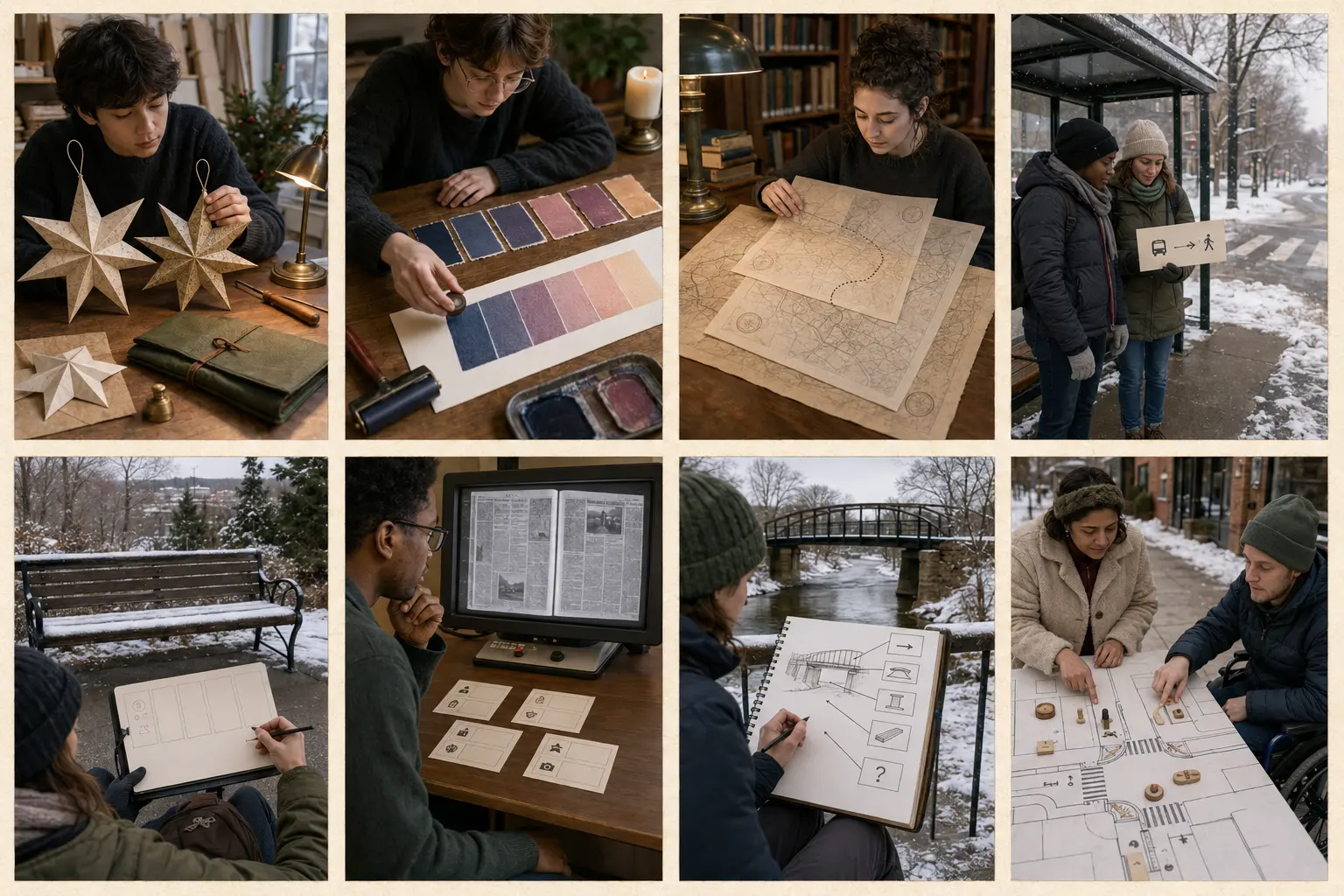
Visit the rider's usual stop at two relevant times and document verified shelter, seating, lighting, curb access, crossing route, real-time information method, weather exposure, snow or debris concerns, nearby safe waiting options, and the rider's preferred fallback. Prepare a concise dossier for personal use and any factual service request they choose to make.
See fit and tradeoffs →With a participant who uses the block and whose expertise is respected, sketch one public block's curb transitions, door thresholds visible from public space, surface breaks, slopes, crossing time, rest points, obstructions, and alternate entrances. Record experience and uncertainty without assigning a universal accessibility score.
See fit and tradeoffs →
With the board owner's permission, remove only expired notices according to policy, group current items by date sensitivity and purpose, preserve required postings, improve readable spacing, and add a dated submission-and-removal guide. Photograph the board before and after only if no personal contact details are exposed.
See fit and tradeoffs →From one safe indoor window, choose a fixed object and record whether a moon shadow appears at the same clock time on three separated clear or partly clear nights. Note official moon information, cloud, indoor reflections, streetlight interference, and no-result nights without manufacturing a shadow.
See fit and tradeoffs →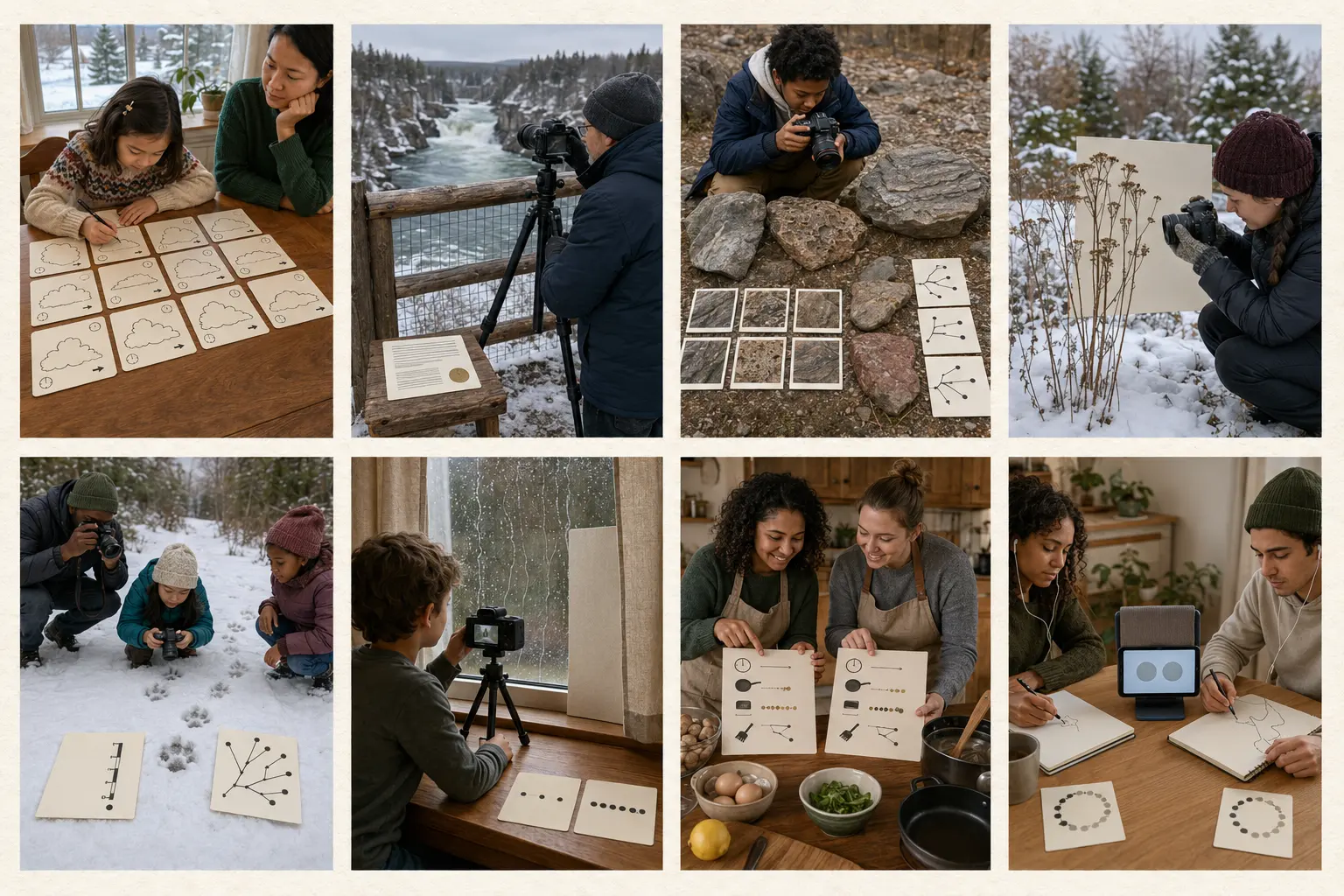
Along one permitted path, photograph six in-place examples that may illustrate cracking, rounding, staining, flaking, biological growth, or human wear, always with a wider context and scale reference that does not touch the surface. Use a reputable educational source to frame possible processes as questions, not diagnoses.
See fit and tradeoffs →Set an existing device securely inside one chosen window and record a short time-lapse focused on raindrop paths while framing out neighboring interiors, faces, addresses, and street detail. Compare two intervals, add an accessible still sequence, and keep the original ambient sound separate rather than fabricating a storm soundtrack.
See fit and tradeoffs →
Each person chooses two safe ordinary objects and records five short sounds in a quiet permitted room, announcing every recording first. Exchange unlabeled clips privately, guess the action rather than the object, then reveal setup, distance, surface, and what made the sound misleading.
See fit and tradeoffs →Each person chooses one document, object, or photograph they own and are comfortable discussing, then gets ten uninterrupted minutes for what it is, what is known, what is uncertain, and what should remain private. Reserve ten minutes for questions that may be declined, with no valuation, scanning, or public sharing.
See fit and tradeoffs →Invite three willing makers to bring one work fragment that can be seen or heard in under three minutes. After each, responders may name what they noticed, where attention changed, and one genuine question, but give no advice, diagnosis, market judgment, or comparison unless the maker later requests a separate conversation.
See fit and tradeoffs →Choose one reputable public collection with clear rights statements and a shared theme, then each person selects three records for a six-image private sequence. Preserve creator, title, date, source, rights status, and uncertainty, write one sequence note together, and link to records rather than redistributing files unnecessarily.
See fit and tradeoffs →
Invite the recipient to a specific thirty-minute tea or chosen drink with arrival, one simple refreshment, no hosting task for them, and a visible closing plan that the giver keeps. Offer home, doorstep, nearby accessible place, or remote versions and make rescheduling or ending early easy.
See fit and tradeoffs →At the actual event hour, test two or three seats for distance from speakers, kitchen clatter, door traffic, bright light, drafts, conversation sightlines, and easy exit. Ask intended users what matters, keep the seats available without labeling them as special, and provide a separate retreat option if possible.
See fit and tradeoffs →With the host and guest preferences in hand, identify active scent sources in the entry, bathroom, shared room, linens, cleaning plan, candles, diffusers, flowers, personal products, and pets. Remove or pause only what the household approves, ventilate according to safe conditions, and communicate honestly about what cannot be changed.
See fit and tradeoffs →
Before one gathering, assign visible finish cues, transport checks, coat return, leftovers choice, final bathroom use, guest goodbyes, dishes to leave, essential cleanup only, and a protected host recovery period. Give one co-host authority to carry the final twenty minutes so the primary host can stop performing hospitality.
See fit and tradeoffs →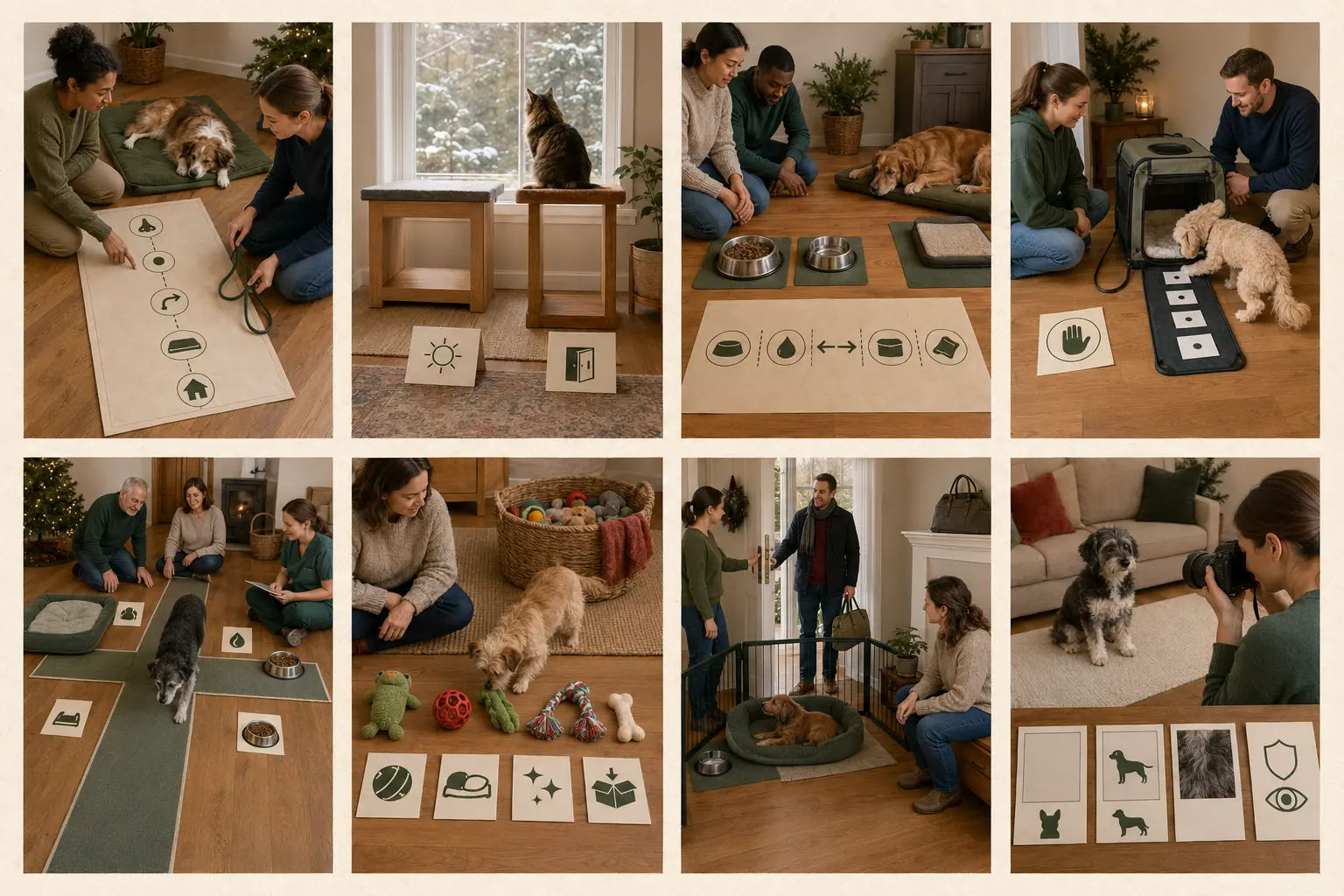
Arrange a walk-and-observe session with a qualified reward-based professional on one ordinary route. Map distance, sniff opportunities, narrow points, triggers, recovery spaces, leash handling, choice points, and a shorter fallback, then let the guardian practice the revised route without setting performance targets for the dog.
See fit and tradeoffs →Using a stable existing chair, platform, or borrowed freestanding perch, trial two window locations for sun, glare, outdoor stressors, escape from children or other animals, radiator and cord clearance, curtain use, cleaning, and the cat's voluntary approach. Observe over several short periods before deciding whether any product is appropriate.
See fit and tradeoffs →With the guardian, inspect existing toys for damage and suitability according to professional and manufacturer guidance, then observe short supervised play with a small selection. Record approach, engagement, interaction needed, arousal, carrying, chewing, rest, and safe storage before rotating only approved toys and retiring hazards with permission.
See fit and tradeoffs →Before guests arrive, rehearse door use, pet location, gates or closed rooms already approved, retreat, water, sound, food boundaries, child instructions, coat and bag placement, outside access, and one responsible adult's role. Use a realistic door knock or message cue only at a level the animal can handle.
See fit and tradeoffs →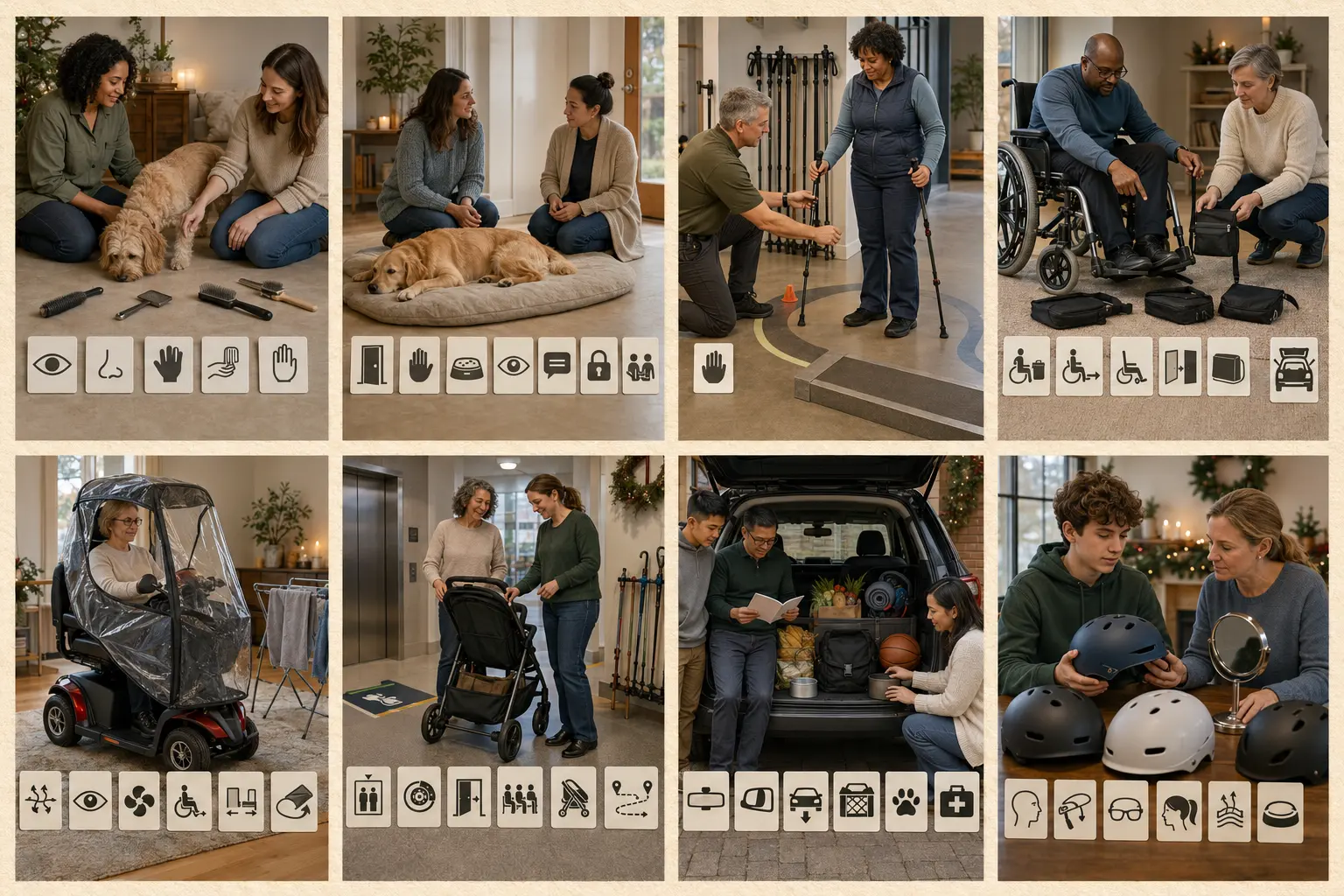
Book a low-pressure session with a qualified groomer or cooperative-care professional to assess coat or nail needs and let the animal investigate a small number of appropriate tools without requiring a full groom. Compare sound, texture, pressure, position, session length, guardian handling, and stop signals before choosing any home practice.
See fit and tradeoffs →Hold one paid or mutually agreed rehearsal visit in which the guardian demonstrates entry, animal greeting or non-greeting, food, water, walk or litter routine, medication only according to authorized instructions, cleaning, retreat, alarms, keys, updates, and emergency contacts. The sitter performs a small part while the guardian observes and corrects the written plan.
See fit and tradeoffs →Without the child aboard, rehearse the actual route with the stroller and ordinary bag load, checking doorway, elevator, platform gap information, folding, brakes, stairs avoided, designated spaces, caregiver hand positions, fare, time, and a missed-vehicle fallback. Recheck current transit policy through official sources.
See fit and tradeoffs →Using the vehicle manual and actual routine load, remove only approved loose clutter, identify factory cargo points and stated limits, and mock up zones for groceries, mobility equipment, sports gear, pet supplies, emergency access, and nothing above safe sightlines. Ask a qualified professional about uncertain restraint or child-seat interactions.
See fit and tradeoffs →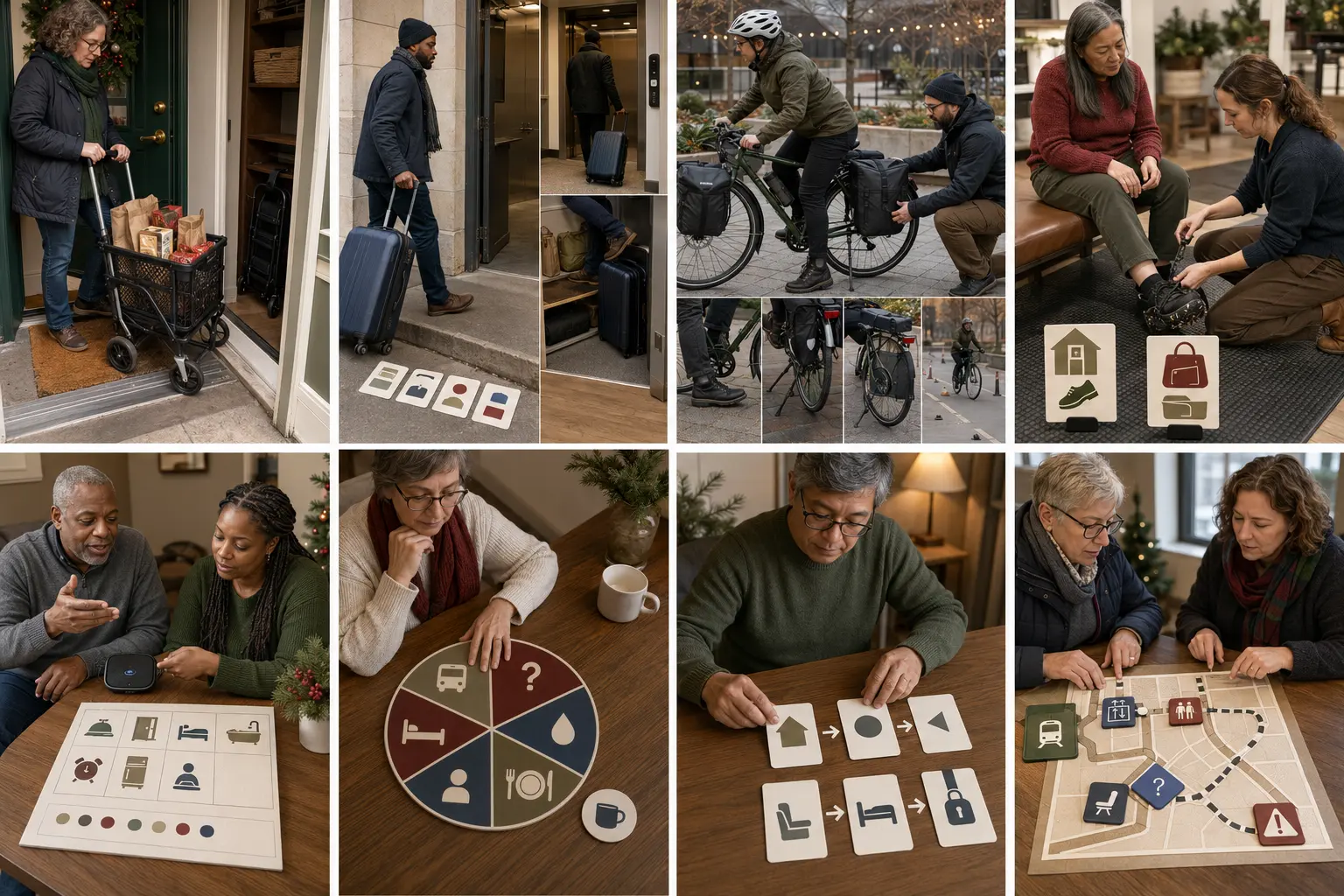
Pack the suitcase to the traveler's realistic weight, then rehearse the home threshold, curb cut, vehicle or transit transfer, elevator, carpet, narrow turn, storage position, and opening without lifting beyond ability. Compare push, pull, companion help, porter, smaller bag, and delivery options before departure.
See fit and tradeoffs →With the traveler, turn their priorities into specific questions about arrival, parking or transit, route, doors, lifts, bed, bathroom, shower, toilet, turning space, seating, alarms, refrigeration, service animals, communication, and backup room. Call or message the property, record who answered and when, request written confirmation, and preserve uncertainty.
See fit and tradeoffs →Map only the first six local hours after arrival: border or station transition, transport, check-in uncertainty, water and familiar food access, required communication, daylight, rest options, essential unpacking, and one cancellation-safe activity. Keep sleep or medical advice with qualified sources and let the traveler choose the pace.
See fit and tradeoffs →Using current official rail and station information, map arrival side, lift or ramp route, assistance meeting point, toilets, seating, platform-change uncertainty, minimum transfer time, luggage handling, communication failure, and the exact missed-connection process. Confirm assistance and ticket terms through the operator close to travel.
See fit and tradeoffs →
Put every proposed trip element on a removable tag and let each traveler mark keep, change, release, or protect for one thing that supports rest, access, relationship, or personal meaning. Build the itinerary only from shared constraints and protected needs, leaving unscheduled space and a daily cancel-without-blame option.
See fit and tradeoffs →Using current carrier dimensions and the traveler's actual bag, mock the under-seat volume and pack only in-journey essentials. Rehearse document and phone access, liquids or screening rules from official sources, medication handling with the traveler's care plan, device power, snacks, sensory items, bag closure, foot space, and what transfers to a seat pocket only when safe.
See fit and tradeoffs →Before departure, agree on the first twelve hours home: one safe simple meal or grocery delivery, clean sleep clothes, essential pet or plant handoff, luggage quarantine area, only urgent laundry, device charging, transport from arrival, and no social obligations. The giver completes the approved preparation and leaves before the household returns if preferred.
See fit and tradeoffs →Offer twelve specific tasks with clear time, cost, access, and handback, such as one pickup, one return, one load of laundry by instructions, one meal portion, one form-reading hour, one pet walk if appropriate, or one quiet reset. The recipient may choose, modify, postpone, or reject every option without explaining.
See fit and tradeoffs →With the household's directions, create a simple shelf and refrigerator map, then receive or help unpack one approved shop by checking damaged packaging, cold items first, allergen separation, heavy-item reach, date awareness, pantry rotation preference, bags, receipt privacy, and an explicit unresolved basket for anything uncertain.
See fit and tradeoffs →
Using one small approved load, compare folding or sorting at the recipient's existing bed, table, counter, lap board, or seated surface, noting reach, posture, leaning, fabric drag, pile stability, transfer to storage, visual sorting, and stopping. Choose the least tiring complete route or decide that helper-folded or no-fold storage works better.
See fit and tradeoffs →Observe one voluntary morning and choose no more than three actions that remove friction before the day starts, such as water, curtains, essential medication according to the recipient's care plan, one clothing decision, bag check, pet need, or first food. Rehearse the sequence in ten minutes with pause and skip cards, then undo anything that creates pressure.
See fit and tradeoffs →For the next three confirmed outings only, use the recipient's own forecast source and approved clothes to prepare coat, footwear, mobility or sensory items, bag, keys, transport card, and wet-return spot on an existing bench, hooks, or rail. Test reach and seated use, then reset or dismantle after the third outing.
See fit and tradeoffs →In one chosen room, list recurring tasks and ask which may be kept, done less often, delegated, combined, made easier, or released. Trial only one recipient-approved change such as a lower-maintenance display, fewer moved objects, easier waste point, helper ownership, or closed unused zone, then review after a week.
See fit and tradeoffs →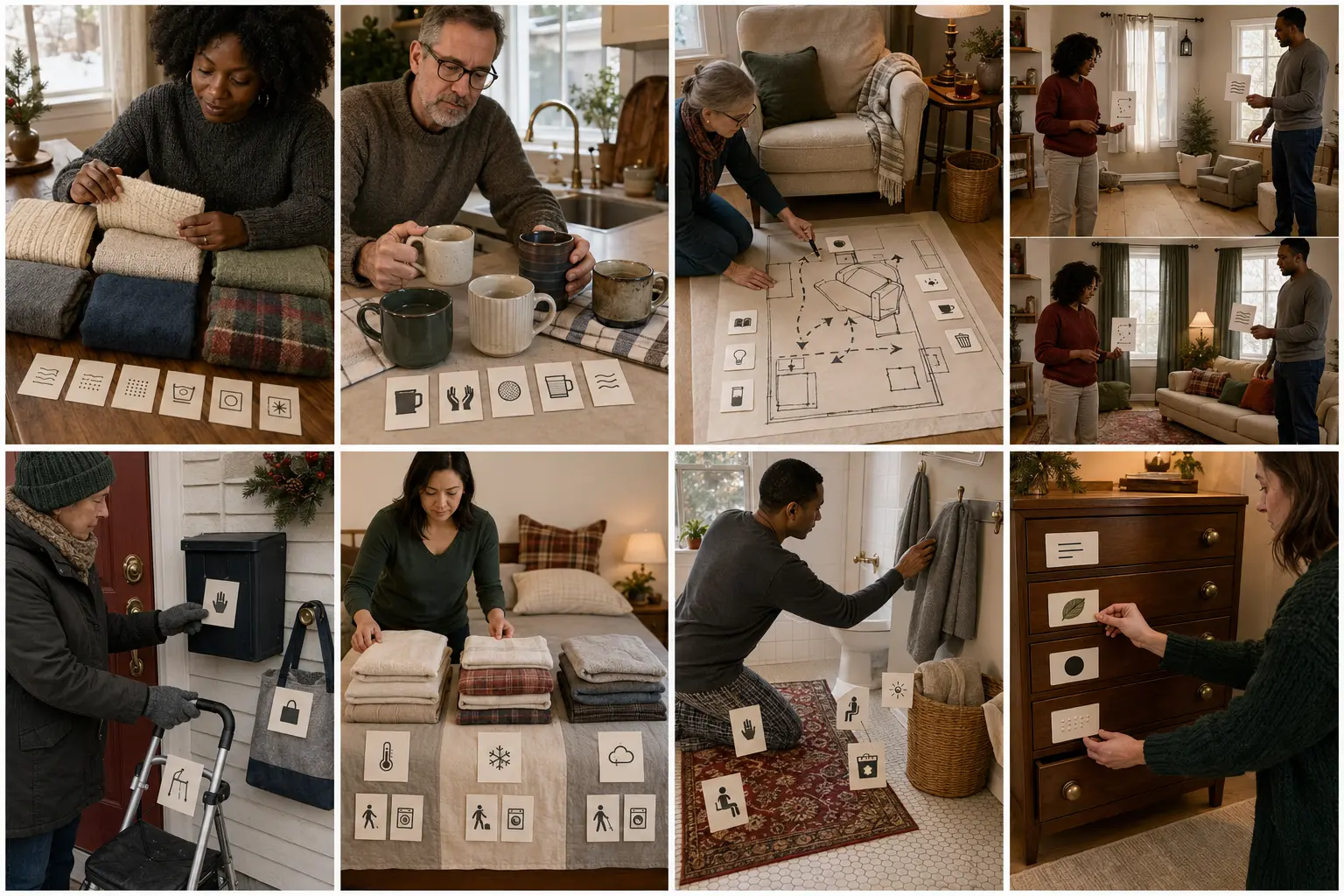
With permission, select small reversible folds from six household textiles already used for bedding, clothing, upholstery, towels, or throws. Compare texture, temperature, pressure, seams, lint, sound, scent, laundering, and skin contact in the intended routine, then record preferences without cutting or relabeling the original items.
See fit and tradeoffs →Using only stable mugs already owned or borrowed returnable samples, test empty and cool-water weight, handle clearance, two-hand support, lip shape, visibility, base stability, coaster grip, cupboard reach, washing, and preferred fill line. Record the best current option or exact verified gap before buying anything.
See fit and tradeoffs →With the reader seated as they choose, map book or device, glasses, drink, light control, blanket, bookmark, charger if used, waste, and clear standing or transfer path. Reposition only existing stable furniture and cord management by consent, test day and evening use, and leave a professional question for pain, posture, or electrical work.
See fit and tradeoffs →Choose one speech or daily-sound problem and compare the room in its original state with reversible placements of existing curtains, rugs, upholstered furniture, cushions, or a filled bookcase already meant for the space. Record perceived speech clarity, echo, cleaning, airflow, light, movement, and shared-room tradeoffs without calling it acoustic treatment.
See fit and tradeoffs →Inventory only recipient-approved sheets, blankets, covers, and sleep clothing, then make three reversible layer combinations for mild, cold, and changing nights. Test weight, texture, heat, ease of turning, foot movement, edge reach, laundering, nighttime removal, and storage, leaving health or sleep concerns to qualified professionals.
See fit and tradeoffs →Using existing towels and only permitted hooks or rails, rehearse reach from the dry side of bath or shower, seated and standing options, identification among household members, wet-floor risk, airflow, complete drying, laundry route, clean storage, and guest use. Mock up removable positions before any installation.
See fit and tradeoffs →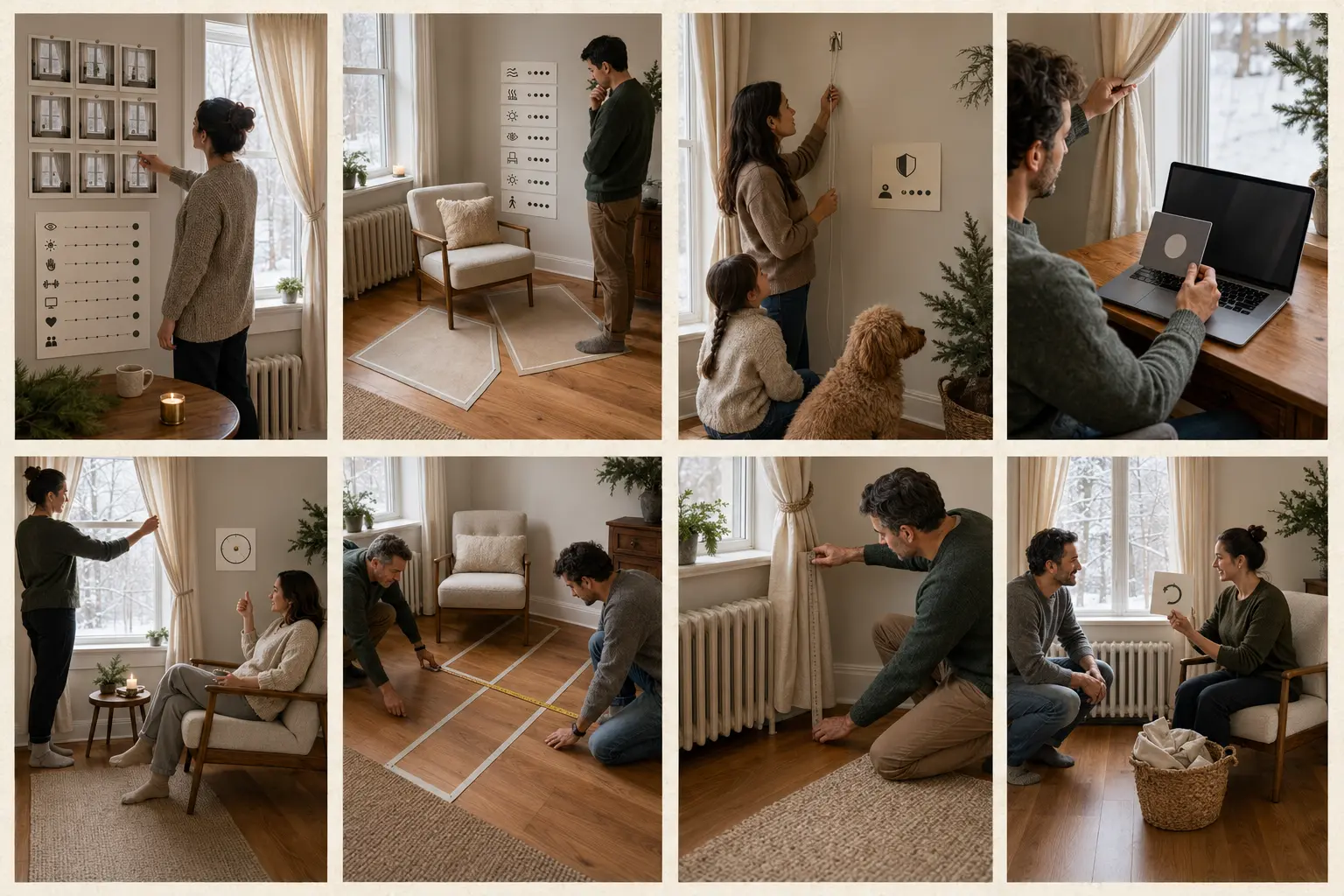
For one week, record the recipient's chosen morning curtain or blind position against privacy, glare, heat perception, plant needs, neighbor sightlines, screen use, reach, cord or wand safety, and energy to operate it. Trial a simpler existing position or helper timing and leave any hardware change to an appropriate professional.
See fit and tradeoffs →Using an existing stable chair, test two temporary positions near the chosen window for draft, radiator or vent clearance, glare, view, privacy, floor temperature, seat support, reading or handwork light, drink placement, transfer, curtain use, and room traffic. Restore the room if neither position works.
See fit and tradeoffs →No placement or order is currently paid. Future commercial links will be clearly labeled beside the link and will not silently determine this collection.